 By Bread Styles Team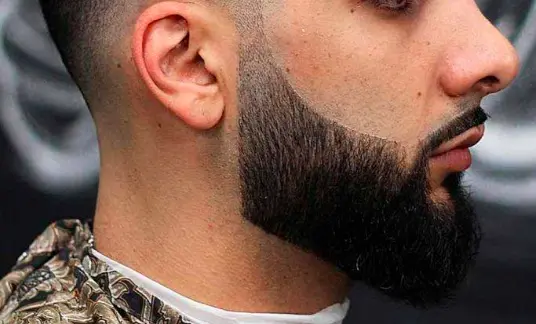
Table of Contents
What Is a Low Fade with Beard? {#what-is-a-low-fade-with-beard}
A low fade with beard is a haircut where the hair fades from short to skin starting just above the ears, with the beard trimmed and blended so it connects cleanly into the fade. The result is a tight, controlled shape on the sides that still leaves plenty of length on top, paired with a beard that looks intentional rather than grown out randomly.
Unlike a high fade, which climbs up near the temples, a low fade keeps the fading close to the hairline. That makes it one of the more subtle and workplace-friendly ways to pair short hair with facial hair, and it’s a big reason barbers get asked for this combination so often.
Why Men Are Choosing a Low Fade with Beard Right Now {#why-men-are-choosing}
A few reasons keep this combination near the top of every barber’s request list.
- It works with almost any hair type. Straight, wavy, curly, or coily hair can all take a low fade well, since the fade sits close to the head rather than relying on volume.
- It’s easier to grow into than a high fade. Because the taper starts low, there’s less bare skin to maintain between visits, so it looks fresh for longer.
- It balances a beard nicely. A low fade with beard gives the jawline more definition without the top-heavy look that can happen when a full head of hair meets a full beard with no structure.
- It reads as polished, not trendy. Offices, weddings, interviews — a low fade with beard rarely looks out of place, which is why it shows up so often among <a href=”https://beardstyles.net/professional-beard-styles/”>professional beard styles</a>.
If you’re still deciding whether a fade is the right move at all, it helps to look at the broader family of <a href=”https://beardstyles.net/beard-fade-styles/”>beard fade styles</a> before committing to how aggressive you want the taper to be.
Types of Low Fade Beard Styles to Try {#types-of-low-fade-beard-styles}
Not every low fade beard combo looks the same. The beard length and shape you pick changes the whole personality of the cut.
Low Fade with Full Beard
This is the classic version — a dense, well-shaped beard sitting above a tight low fade. It suits guys with strong beard growth and works especially well when paired with a defined <a href=”https://beardstyles.net/beard-neckline/”>beard neckline</a> and clean <a href=”https://beardstyles.net/beard-cheek-line/”>cheek line</a>. It’s one of the more versatile options among <a href=”https://beardstyles.net/types-of-beard-styles/”>types of beard styles</a> because it can go rugged or refined depending on how tight you keep the trim.
Low Fade with Stubble
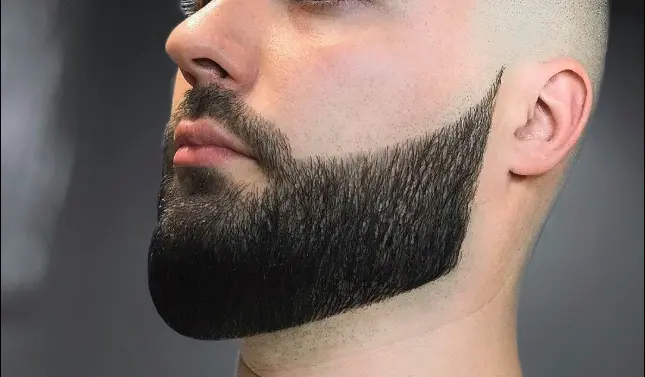
For a lighter, more relaxed look, a low fade paired with heavy stubble gives you texture without the bulk of a full beard. It’s low-maintenance day to day and still looks deliberate. If patchy growth is a concern, stubble is usually more forgiving than a longer beard — worth reading through the <a href=”https://beardstyles.net/stubble-beard/”>stubble beard guide</a> for the exact lengths that work best.
Low Fade with Goatee
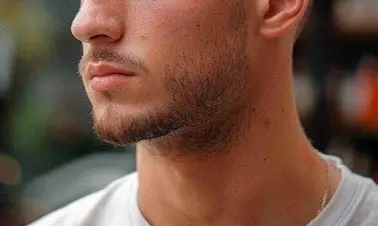
Dropping the cheek hair and keeping growth around the chin and mustache gives a sharper, more angular finish. This pairing tends to suit rounder faces particularly well, since it adds length and structure to the lower half of the face.
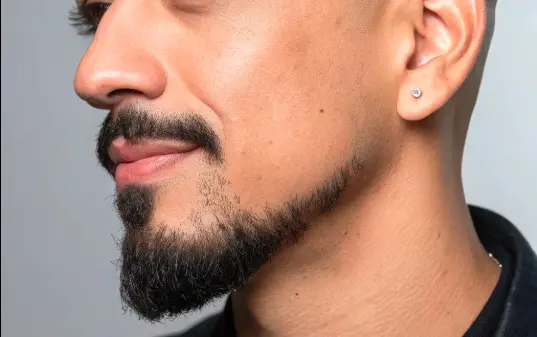
Low Fade with Circle Beard
A tighter, more compact option that connects the mustache to a rounded chin beard. It’s a good pick for guys who want something neat and precise rather than bulky — check the <a href=”https://beardstyles.net/circle-beard/”>circle beard guide</a> if the growth pattern and shaping steps aren’t familiar yet.
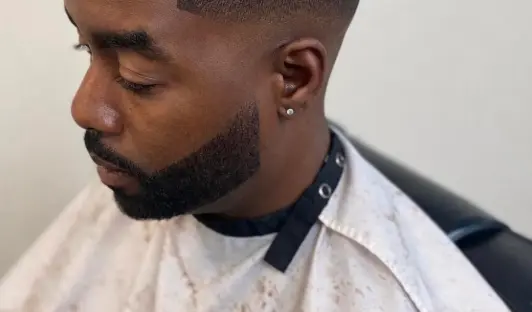
Low Fade with Short Beard
If you want something between stubble and a full beard, a short, tidy beard keeps things clean and requires less shaping maintenance than longer styles. It also tends to be one of the more approachable entry points among <a href=”https://beardstyles.net/short-beard-styles/”>short beard styles</a> for anyone new to pairing facial hair with a fade.
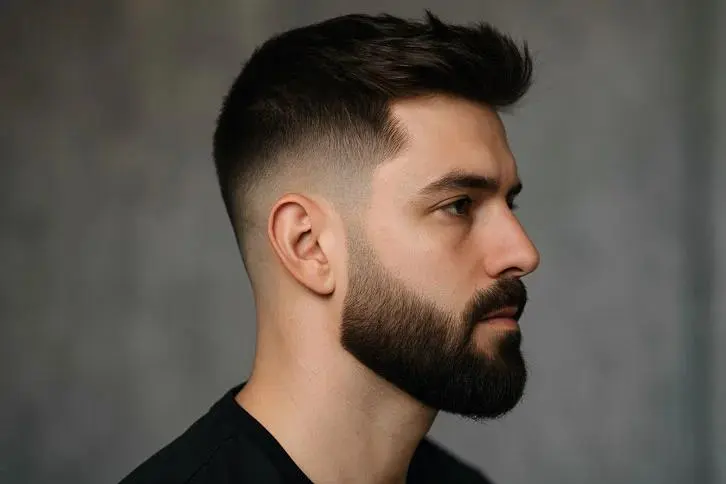
Low Fade with Beard by Face Shape {#face-shape}
A low fade with beard flatters most face shapes, but the beard length and jaw shaping should change based on your face. Rounder faces benefit from more length at the chin, while longer faces do better with fuller width at the sides.
| Face Shape | Recommended Beard Length | Notes |
| Round | Medium to full, angled jawline | Adds length, avoids extra roundness |
| Square | Short to medium, softened corners | Fade highlights the jaw without over-sharpening it |
| Oval | Almost any length works | Most flexible face shape for this combo |
| Diamond | Fuller at the jaw, lighter at cheekbones | Balances a narrower chin |
| Oblong | Fuller sides, shorter chin length | Adds width instead of length |
| Heart | Fuller at the jawline | Balances a wider forehead |
| Triangle | Fuller through the jaw and cheeks | Adds width to a narrower jaw |
For a deeper breakdown by face shape, the guides on the <a href=”https://beardstyles.net/best-beard-for-round-face/”>best beard for a round face</a>, <a href=”https://beardstyles.net/best-beard-for-square-face/”>best beard for a square face</a>, and <a href=”https://beardstyles.net/best-beard-for-oval-face/”>best beard for an oval face</a> go into more specific shaping advice.
Low Fade Haircut Beard: Matching Your Hair Texture {#hair-texture}
The “haircut” side of a low fade haircut beard matters as much as the beard itself, and hair texture changes how it should be cut.
- Straight hair fades cleanly and shows a sharp line between the skin and the hair, which is why it’s often the easiest texture for a barber to work with.
- Wavy hair blends a little softer at the fade line, giving a more textured, natural transition.
- Curly hair can hold more volume on top, which pairs well with a tighter low fade underneath to keep the whole look balanced rather than top-heavy.
- Coily hair often looks sharp with a low fade because the contrast between the tight curl pattern on top and the faded sides reads as very intentional.
Whatever texture you’re working with, a beard that’s kept slightly shorter than the hair on top usually looks more proportional, and it’s worth asking your barber to check that balance before you leave the chair.
How to Ask Your Barber for a Low Fade with Beard {#how-to-ask-barber}
Getting the exact result you want comes down to communication as much as the barber’s skill. Walk in with these points ready.
- Name the fade height. Say “low fade” specifically, and if you have a reference photo, bring it. Barbers interpret “fade” differently, so a photo removes the guesswork.
- Decide how connected you want the beard. Ask whether you want the fade to blend directly into the beard or leave a slightly visible line between the two.
- Set your neckline and cheek line preferences. A natural neckline looks more rugged; a defined one looks sharper. The same applies to how high you want the cheek line trimmed.
- Mention your face shape if you know it. Barbers can adjust jaw shaping accordingly, which ties back to the face shape guidance above.
- Ask for guard numbers used. Knowing the clipper guards used on both the fade and the beard makes it much easier to maintain the look yourself between visits.
Bringing this level of detail is especially useful for anyone requesting a <a href=”https://beardstyles.net/beard-fade/”>beard fade</a> for the first time, since it removes most of the back-and-forth guesswork during the appointment.
Maintenance and Upkeep Routine {#maintenance}
A low fade with beard looks sharp on day one, but it needs a routine to stay that way.
Weekly routine:
- Trim the fade line every 1–2 weeks to stop it from growing out and blurring into the beard.
- Clean up the neckline and cheek line every 5–7 days to keep the shape crisp.
- Wash the beard 2–3 times a week with a dedicated <a href=”https://beardstyles.net/beard-shampoo/”>beard shampoo</a> rather than regular shampoo, which can dry out facial hair.
- Apply <a href=”https://beardstyles.net/beard-oil/”>beard oil</a> daily to keep the skin underneath comfortable and reduce itchiness.
Every 3–4 weeks:
- Book a fresh fade appointment, since the low fade grows out faster than the beard itself and needs the most frequent attention.
- Trim the overall beard length so it stays proportional to the fade.
For a full step-by-step trimming process at home between salon visits, the <a href=”https://beardstyles.net/how-to-trim-a-beard/”>how to trim a beard</a> guide and general <a href=”https://beardstyles.net/beard-care-guide/”>beard care guide</a> cover the techniques in more detail than we can fit here.
Common Mistakes to Avoid {#mistakes}
- Letting the fade grow out too long between cuts. A low fade needs upkeep every few weeks — stretching it too far defeats the point of getting a fade in the first place.
- Ignoring the connection between fade and beard. If the barber doesn’t blend the two, you can end up with an awkward gap of longer hair between the sideburn and the beard.
- Skipping skin care underneath. Razors and clippers close to the skin can cause irritation or ingrown hairs, especially on curly or coily hair types. The American Academy of Dermatology recommends trimming in the direction of hair growth to reduce this risk.
- Choosing beard length without considering face shape. A beard that works on one face shape can look unbalanced on another — refer back to the face shape table above before deciding.
- Over-styling with product. Too much beard balm or oil can weigh the beard down and make the fade look disconnected rather than blended.
Low Fade vs Mid Fade vs High Fade with Beard {#comparison}
| Feature | Low Fade | Mid Fade | High Fade |
| Fade starting point | Just above the ear | Mid-way up the side of the head | Near the temple |
| Maintenance frequency | Every 3–4 weeks | Every 2–3 weeks | Every 2 weeks |
| Best for | Workplace, subtle looks | Balanced, versatile styles | Bold, high-contrast looks |
| Beard pairing | Blends easily with most beard lengths | Works well with medium to full beards | Best with fuller beards for balance |
| Growing-out tolerance | High | Medium | Low |
If a low fade feels too subtle, it’s worth comparing it against the broader range of <a href=”https://beardstyles.net/beard-styles-with-fade/”>beard styles with fade</a> to see how the mid and high options change the overall look before booking your next cut.
Styling Difficulty, Best Age Groups and Who It Suits {#who-it-suits}
Styling difficulty: Low. Once the fade and beard are shaped by a barber, day-to-day maintenance is mostly trimming and washing rather than complex styling.
Best age groups: A low fade with beard suits a wide range of ages because it’s subtle rather than trend-driven. It works for younger men building their first proper beard as much as it does for men in their 40s and 50s who want a sharp, low-maintenance look that still reads as mature and professional.
Who it suits:
- Men in office or client-facing jobs who want facial hair without looking unkempt
- Men with straight to coily hair, since the fade sits close to the head regardless of texture
- Men who want a beard that looks shaped rather than just “grown out”
- Anyone easing into their first fade, since low fades grow out more gracefully than higher ones
Best Products for a Low Fade Beard Combo {#products}
A good low fade haircut beard holds up best with a small, consistent product routine rather than a large collection used inconsistently.
- Beard trimmer: A quality <a href=”https://beardstyles.net/beard-trimmer/”>beard trimmer</a> with multiple guard lengths makes it far easier to maintain the neckline and cheek line between barber visits.
- Beard oil: Keeps the skin under the beard comfortable, especially where the fade meets the beard line and skin is more exposed.
- Beard balm: Useful for holding shape on fuller beard lengths without leaving hair greasy.
- Beard wash: A sulfate-free <a href=”https://beardstyles.net/beard-wash/”>beard wash</a> keeps facial hair clean without stripping natural oils the way body soap can.
A simple, repeatable routine using two or three products consistently will do more for how the style holds up than switching between a dozen different ones.
Final Thoughts {#final-thoughts}
A low fade with beard earns its popularity honestly — it’s flattering across most face shapes and hair textures, it’s easier to maintain than higher fades, and it strikes a balance between sharp and low-key that few other combinations manage. Whether you go for a full beard, stubble, or a tighter goatee shape, the key is communicating clearly with your barber and keeping up with the maintenance schedule so the fade doesn’t outgrow the beard around it.
FAQs {#faqs}
What is a low fade with beard?
A low fade with beard is a haircut where the sides fade from short to skin starting just above the ears, blended into a trimmed and shaped beard for a clean, connected look.
How often does a low fade with beard need to be maintained?
The fade typically needs a touch-up every 3–4 weeks, while the beard’s neckline and cheek line should be cleaned up every 5–7 days to keep the shape sharp.
Is a low fade with beard good for round faces?
Yes. A low fade with beard works well for round faces when the beard is kept slightly fuller and more angled at the jaw, which adds length and structure.
Does a low fade with beard suit curly hair?
Yes. Curly hair pairs well with a low fade because the fade sits close to the head, creating contrast with the volume left on top.
What’s the difference between a low fade and a mid fade with a beard?
A low fade starts just above the ear and needs less frequent maintenance, while a mid fade starts higher on the side of the head and creates a bolder contrast.
Can I do a low fade with beard myself at home?
Basic upkeep like the neckline and beard length is manageable at home with a good trimmer, but the fade itself is best left to a barber for a clean blend.
What beard length works best with a low fade?
Most lengths work, from stubble to a full beard, though short to medium beards tend to be the easiest to keep proportional to a low fade.
Is a low fade with beard appropriate for work?
Yes, it’s one of the more workplace-friendly fade options because the taper stays subtle rather than dramatic.
How long does it take to grow into a low fade with beard?
Growing a well-shaped beard usually takes 4–8 weeks depending on your natural growth rate, though the fade itself can be added at any point once there’s enough hair on top to work with.
Does a low fade with beard work for teenagers?
It can, as long as facial hair growth is developed enough to shape into a clean beard line rather than looking patchy.
What should I tell my barber for a low fade with beard?
Specify “low fade,” bring a reference photo if possible, and mention how connected you want the fade to be to the beard along with your preferred neckline style.
Can a low fade with beard cause skin irritation?
It can if the skin isn’t cared for properly. Using a beard oil regularly and trimming in the direction of hair growth helps reduce irritation and ingrown hairs.
Is a low fade with beard low maintenance?
Compared to higher fades, yes — it grows out more gracefully and needs less frequent barber visits, though beard trimming should still be kept up weekly.
What face shapes should avoid a full beard with a low fade?
No face shape needs to avoid it entirely, but oblong and diamond faces generally look more balanced with fuller sides rather than extra length at the chin.
Does hair texture affect how a low fade with beard looks?
Yes. Straight hair shows the sharpest fade line, while curly and coily textures create more natural blending between the fade and the hair on top.