 By Beard Style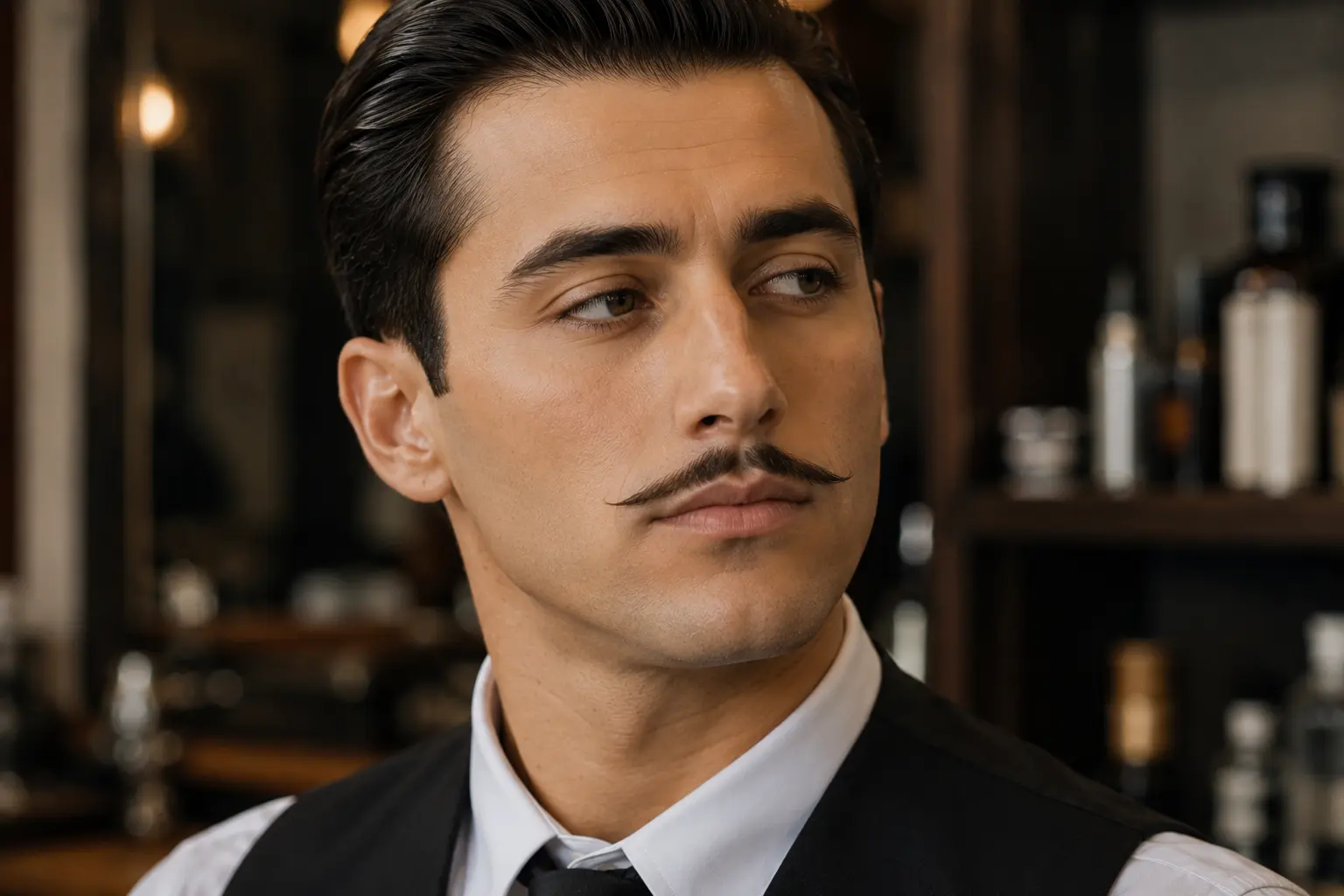
If you’ve ever watched an old Clark Gable film or admired the sharp, tailored look of a 1930s gentleman, you’ve already seen a pencil mustache in action. It’s one of the thinnest, most precise facial hair styles a man can wear, and it’s making a genuine comeback among men who want something more refined than a full beard or a bold handlebar mustache.
A pencil mustache is a narrow strip of hair trimmed to follow the natural line just above the upper lip, kept thin enough that it looks almost drawn on with a pencil, which is exactly where the name comes from. It’s a style built on precision rather than volume, and that’s both its biggest advantage and its biggest challenge.
This guide covers everything you actually need before growing one: who it suits, how to shape it, which tools work best, how often to maintain it, and the mistakes that turn a sharp pencil mustache into a patchy mess.
Table of Contents
What Is a Pencil Mustache
A pencil mustache is a thin mustache style trimmed down to a narrow line that hugs the upper lip, usually no more than a few millimeters thick. Unlike a full mustache or a chevron mustache, there’s no bulk to hide behind. Every hair is visible, so the line has to be clean and symmetrical.
The style sits in a strange middle ground: it’s technically low-maintenance in terms of hair volume, since you’re removing most of it, but high-maintenance in terms of precision, since any unevenness stands out immediately.
Men choose this style for its retro, old-Hollywood charm, its ability to add definition to a face without committing to heavier facial hair, and the sharp, deliberate impression it gives off compared to stubble or a beard without mustache.
A Short History of the Classic Mustache
The pencil mustache has roots that stretch back further than most people assume. Thin, groomed mustaches appeared across Latin American and European fashion through the early twentieth century, but the style became a true cultural icon in Hollywood’s golden age.
Actors like Clark Gable and Errol Flynn wore it as a symbol of confidence and old-world charm, and it later became associated with lounge singers, magicians, and even villain characters in film, which gave it a slightly theatrical reputation for decades. Today it’s shed most of that costume-like association and is worn simply as a classic mustache with a vintage edge, particularly by men who want something distinct from the beard styles that dominate current trends.
Who Should Wear a Pencil Mustache
This isn’t a style for every man, and that’s fine, because no facial hair style is universal. It tends to suit:
- Men with straight, well-behaved facial hair that grows in evenly along the lip line
- Men who prefer a groomed, formal look over a rugged one
- Men in creative, hospitality, or performance industries where a distinct look is an asset
- Men who don’t mind a grooming routine that requires a steady hand every few days
- Men who want facial hair without the weight or heat of a full beard
It’s generally a poor match for men with patchy upper-lip growth, since a pencil mustache style leaves nothing to hide gaps. If your mustache area grows in thin or uneven, a slightly fuller style like a chevron mustache will look more intentional.
Best Face Shapes for a Pencil Mustache
Face shape genuinely changes how this style reads, more than with most beard styles, because there’s no volume to balance out proportions.
| Face Shape | Suitability | Why |
| Oval | Excellent | Balanced proportions work with almost any thin mustache style |
| Square | Good | Softens a strong jawline without adding bulk |
| Long/Oblong | Good with a slightly wider line | A thin line drawn a touch wider horizontally can shorten the perceived length of the face |
| Round | Fair | Keep the line sharp and slightly upturned at the corners to add definition |
| Diamond | Fair | Works best paired with subtle cheek definition |
| Heart | Fair | Pairs well with a soul patch beard for added lower-face balance |
If you’re unsure how facial hair interacts with your bone structure, it’s worth comparing notes with a broader resource like our guide on the best beard for oval face or the best beard for square face, since the same balancing principles apply to mustache-only styles.
Pencil Mustache vs Other Thin Mustache Styles
People often confuse a pencil mustache with other thin mustache styles, but the differences matter once you’re in front of the mirror with trimmers.
| Style | Width | Shape | Best For |
| Pencil Mustache | Very thin, hairline width | Straight, close to the lip | Formal, retro look |
| Horseshoe Mustache | Thick, full width | Extends down past the mouth corners | Bold, rugged look |
| Chevron Mustache | Medium to full | Covers the entire upper lip, no gap | Classic masculine look |
| Handlebar Mustache | Medium, with long tips | Curled or waxed ends | Statement, vintage-bold look |
If you’ve considered a horseshoe mustache or a handlebar mustache but want something quieter, the pencil version is essentially the opposite end of the spectrum: minimal, precise, and understated rather than a statement piece. Men who like the classic mustache family but want more coverage sometimes land on a chevron mustache instead, which keeps the same upper-lip focus but with noticeably more density.
How to Grow a Pencil Mustache Step by Step
Growing into this pencil beard style takes patience before you touch a trimmer.
- Stop shaving the upper lip completely for at least three to four weeks. You need to see the full growth pattern before shaping anything.
- Resist the urge to trim early. Cutting a thin line into short, uneven growth almost always looks patchy. Let it grow out fully first.
- Wash and comb the area daily with a mild cleanser to keep skin healthy underneath the new growth.
- Study your natural growth line once it’s fully in. Note where hair grows thickest and where it thins out, since this determines how thin your final line can realistically go.
- Book a first shape with a barber if this is your first attempt. A professional shaping the initial line gives you a template to copy at home afterward.
Tools You Need for a Pencil Beard Style
Precision work needs precision tools. A basic beard trimmer alone won’t cut it here.
- Fine-tooth trimmer with a zero-gap or detail blade for the actual thin line
- A single-blade or double-edge razor for cleaning the edges above and below the line
- Small grooming scissors for trimming stray or longer hairs before shaping
- A magnifying mirror since small errors are much easier to catch enlarged
- Pre-shave oil or a light moisturizer to reduce irritation on such a small, sensitive area
- A fine comb to lift and separate hair before every trim
Skipping a magnifying mirror is one of the most common reasons a pencil mustache ends up crooked. The line is thin enough that even a millimeter of unevenness is visible from a normal conversational distance.
How to Trim and Shape It Correctly
This is where most men either get the pencil mustache style right or ruin weeks of growth in one pass.
- Comb the mustache downward and outward so every hair is visible and lying flat.
- Mark your top line first, following the natural border just under the nose. This line rarely needs cutting since it’s your growth boundary.
- Decide your bottom line, which is the one you’ll actually be shaping thinner. Use the fine-tooth trimmer along this line first, working from the center outward toward each corner.
- Trim symmetrically, working a small section on one side, then matching it exactly on the other side, rather than finishing one side completely first.
- Clean the space above the lip and below the nose with a razor for sharp edges.
- Check the corners, since pencil mustaches typically taper slightly at the ends rather than stopping abruptly.
- Step back from the mirror and check symmetry from a distance, since close-up mirror work can distort how even the line actually looks.
Go slower than feels necessary on your first few attempts. You can always trim more; you can’t add hair back if you take off too much.
Maintenance Routine and Frequency
Because there’s so little hair to work with, upkeep needs to be frequent and small, rather than occasional and dramatic.
- Trim every 2 to 4 days. Facial hair grows fast enough that a pencil mustache line will blur within a few days if left alone.
- Clean the surrounding skin daily to prevent ingrown hairs, since this area sees frequent razor contact.
- Moisturize after every trim, since repeated shaving close to the lip can dry out the skin faster than beard skin elsewhere.
- Re-check symmetry weekly under good lighting, not just after each trim, since small drifts add up over several sessions.
This routine is noticeably more frequent than most beard styles or even a stubble beard, which is worth factoring in before committing if your schedule doesn’t allow for regular five-minute grooming sessions.
Common Mistakes to Avoid
- Trimming before full growth. Shaping too early locks in a pattern that doesn’t match your actual growth line.
- Making it too thin, too fast. Reduce width gradually over several sessions rather than cutting straight to the thinnest look on day one.
- Ignoring face shape. A pencil mustache style that’s straight and flat can look flat on a round face; a slight upward taper at the ends helps.
- Skipping the magnifying mirror. Small asymmetries are invisible up close without one and obvious from across a room.
- Neglecting skin care. Frequent shaving in one small area causes more irritation than people expect. Unscented aftershave balm helps.
- Copying a photo exactly. Growth patterns differ from person to person; use references as inspiration, not an exact template.
Styling Difficulty and Realistic Expectations
Rating this honestly matters more than making it sound easier than it is.
- Growing phase difficulty: Low. It just takes patience and not touching it for a few weeks.
- Shaping difficulty: High. This is one of the more technical facial hair styles to get right, especially the first few attempts.
- Maintenance difficulty: Medium-high. Frequent small trims are required to keep the line sharp.
- Time investment: Roughly 5 to 10 minutes every 2 to 4 days once established.
Realistically, expect your first two or three attempts to be imperfect. Barbers spend years perfecting thin-line work, and most men need a handful of tries before the shape becomes consistent without a professional’s help.
Variations of the Pencil Mustache
The classic mustache doesn’t have to mean one rigid shape. A few common variations:
- Straight Pencil: A completely flat, uniform line, the most traditional take.
- Tapered Pencil: Slightly thinner at the outer corners for a softer finish, often better suited to rounder faces.
- Upturned Pencil: Corners angled subtly upward, giving a more playful or theatrical impression.
- Pencil with Soul Patch: Paired with a small soul patch beard below the lip for a touch more lower-face structure, popular among men with heart-shaped faces.
If the fully bare-cheek look feels too stark, some men pair a thin mustache with very light stubble on the jawline rather than a bare face, blending the retro mustache with a slightly more modern, textured look elsewhere.
Expert Barber Tips
A few things worth knowing that most guides skip over:
- Trim right after a shower, when hair is softer and skin is warm, but pat the area fully dry first so hair lies in its natural position rather than clinging to damp skin.
- Use short, controlled trimmer strokes rather than long sweeping passes. Long strokes are where most crooked lines happen.
- If your growth is naturally patchy, a pencil mustache will expose that more than almost any other style. Consider a chevron mustache or fuller upper-lip style instead until growth fills in more evenly.
- For dermatological concerns like persistent razor bumps or irritation in the mustache area, the American Academy of Dermatology recommends letting the skin recover before continuing frequent shaving in the same spot.
- Keep a small set of grooming scissors dedicated only to this area. Using the same blade you use for eyebrows or nose hair introduces bacteria into a spot that’s shaved frequently and prone to small nicks.
For a broader grooming routine that covers everything beyond just this one style, our beard care guide and how to trim a beard resources both cover skin health and tool care in more depth.
Conclusion
A pencil mustache rewards patience and a steady hand more than any other single grooming style on this list. Get the growing phase right, invest in a decent detail trimmer and a magnifying mirror, and commit to trimming it every few days rather than letting it drift. Done well, it’s one of the sharpest, most distinctive classic mustache looks a man can wear. Done carelessly, it’s one of the quickest to look messy. Start slow, shape gradually, and don’t be discouraged if your first attempt needs a few rounds of adjustment before it looks the way you pictured it.
FAQs
What is a pencil mustache? A pencil mustache is a very thin, precisely trimmed mustache style that follows the natural line above the upper lip, kept narrow enough to resemble a line drawn with a pencil.
Is a pencil mustache still in style? Yes. While it peaked in popularity during Hollywood’s golden age, the pencil mustache has returned as a retro-inspired classic mustache option, particularly among men who want a distinct, groomed look.
How long does it take to grow a pencil mustache? Most men need 3 to 4 weeks of full growth before there’s enough hair to shape into a clean, thin line. Trimming too early usually results in an uneven shape.
How often do you need to trim a pencil mustache? Every 2 to 4 days on average, since fast regrowth quickly blurs the sharp edge that defines this thin mustache style.
Does a pencil mustache suit every face shape? Not perfectly. It works best on oval and square face shapes and can be adapted for round or long faces with slight width or taper adjustments.
What’s the difference between a pencil mustache and a chevron mustache? A pencil mustache is thin and narrow, showing skin around it, while a chevron mustache is full and covers the entire upper lip with no visible gaps.
Can men with patchy facial hair grow a pencil mustache? It’s difficult. Because the style is so thin, any gaps in growth are highly visible. A fuller style is usually a better fit for patchy growth.
What tools do I need for a pencil mustache style? A fine-tooth or detail trimmer, a single-blade razor for edges, small grooming scissors, and a magnifying mirror for precision.
Is a pencil mustache hard to maintain? The maintenance itself is quick, usually 5 to 10 minutes, but it needs to happen frequently and precisely, which makes it more demanding than lower-maintenance beard styles.
Should I get my first pencil mustache shaped by a barber? Yes, if possible. A barber can establish a clean, symmetrical first line that you can then maintain and replicate at home.
Can I pair a pencil mustache with a beard? Generally no. The style is meant to stand alone as a classic mustache look. Pairing it with heavier facial hair usually clashes with its precise, minimal aesthetic, though a small soul patch is sometimes an exception.
What causes an uneven pencil mustache line? Trimming too close to the mirror without stepping back to check symmetry, using long trimmer strokes instead of short controlled ones, and shaping before full growth are the most common causes.
Is the pencil mustache considered a professional look? Yes, it’s generally viewed as a neat, formal style, though workplace grooming policies vary, so it’s worth checking any industry-specific expectations first.
What skin care does a pencil mustache area need? Daily moisturizing and gentle cleansing help prevent irritation and ingrown hairs, since the area is shaved or trimmed more frequently than most facial hair styles.
Does a pencil mustache work with a mustache-only look, or should I add other facial hair? It’s typically worn as a mustache-only style. If you want more facial hair without losing the pencil mustache’s character, keeping cheeks and chin completely bare is the traditional approach; for other bare-cheek options, our guide on beard without mustache covers the opposite pairing in more detail.