 By Bread Styles Team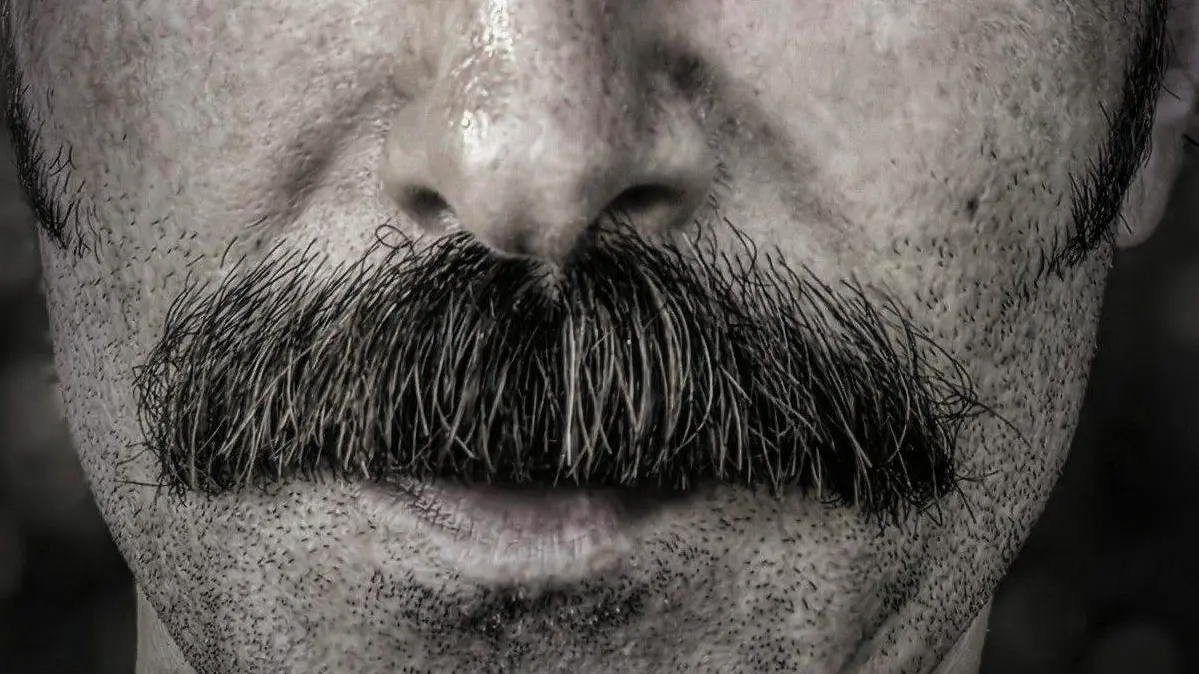
A chevron mustache is a full, wide mustache that covers the entire upper lip from edge to edge, with no gap at the center and no curled or shaped ends. It’s thick by design, sits flat rather than pointing upward, and reads as one of the more masculine, no-nonsense mustache styles for men who want facial hair that doesn’t need daily styling.
If you’ve landed here, you’re probably weighing up whether your natural mustache growth is dense enough to pull this off, how it compares to other full mustache styles, or how to actually shape and trim it so it looks deliberate rather than simply unshaven. This guide covers all three, along with the maintenance side that most articles gloss over.
Table of Contents
1. What Is a Chevron Mustache?
A chevron mustache is a thick, wide mustache that fully covers the upper lip, extending from one corner of the mouth to the other without any curling, tapering, or shaping at the ends. Unlike styles that rely on wax and technique, the chevron mustache style depends almost entirely on natural density and even growth across the whole width of the lip.
Quick snippet answer: A chevron mustache is a full-width mustache that covers the entire upper lip evenly, without curled ends or center gaps. It’s defined by thickness and width rather than shaping, making it one of the lower-maintenance mustache styles for men.
It’s a shape rather than a styling technique, which is part of why it appeals to men who want a strong, masculine mustache without spending time on daily wax or curling.
2. Where the Chevron Mustache Comes From
The chevron mustache became a defining look of the 1970s and early 1980s, closely tied to the era’s broader facial hair culture. It picked up its name from its resemblance to a chevron shape — wide and straight rather than pointed. Public figures from that period, including actors and musicians known for a fuller, straightforward mustache, kept the style visible in mainstream culture well beyond that decade, and it’s resurfaced repeatedly since as a retro-leaning but still wearable choice.
Unlike more elaborate mustache shapes, the chevron never really needed a cultural revival to stay relevant — it’s remained a fixture in barbershops because it’s genuinely practical, not just because it looks retro.
3. Chevron Mustache vs Other Mustache Styles for Men
Seeing the chevron mustache next to other common full mustache styles makes the differences clearer.
| Style | Width | Ends | Styling Needed | Density Required |
| Chevron mustache | Full width, edge to edge | Flat, no curl | Minimal | High |
| Handlebar mustache | Full width | Curled upward with wax | High | Moderate to high |
| Walrus mustache | Full width, often longer | Hangs down over the lip | Low | High |
| English mustache | Full width | Extended straight out, no curl | Moderate | Moderate |
| Horseshoe mustache | Extends down past the mouth, connects to beard sides | Straight down | Low | High |
| Pencil mustache | Thin line only | None | High precision, low density | Low |
The chevron sits closer to the walrus and horseshoe in terms of low daily styling, but it’s noticeably shorter and neater than both, which is part of why it works better in more settings. Compared with a handlebar mustache, the difference comes down entirely to the ends — the chevron stays flat while the handlebar depends on wax and curling to hold its signature shape.
4. Why a Chevron Mustache Needs Thick Growth
This is the detail most guides skip. Because the chevron mustache has no curling, tapering, or center part to distract from thin patches, any unevenness in density shows immediately. A genuinely thick mustache is what makes this style read as intentional rather than simply “not shaved yet.”
If your mustache grows in with visible gaps, particularly near the center under the nose, a chevron will expose that more than a style that curls the ends or narrows the width. In that case, a circle beard or a connected style might suit your natural growth better than an isolated chevron.
5. Types of Chevron Mustache Styles
Not every chevron mustache style is identical in size and length.
Classic Wide Chevron
The most recognizable version — full width, moderate length, sitting flat and even across the entire upper lip. This is the standard reference point for the style.
Tapered Chevron
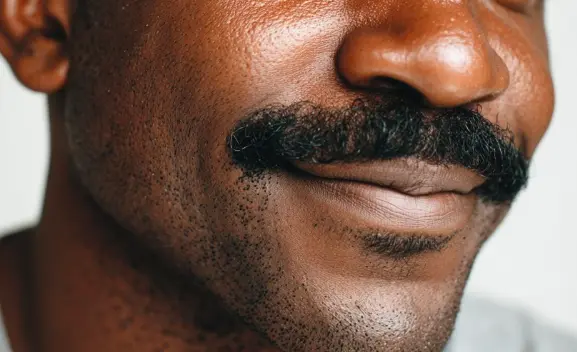
Slightly narrower at the outer edges than the classic version, giving a marginally softer look while keeping the same full coverage across the center.
Short-Trimmed Chevron
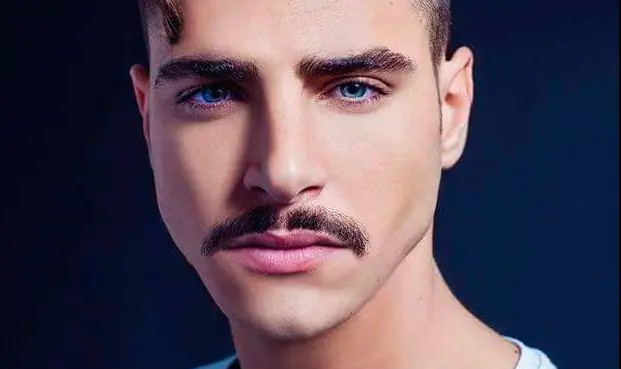
Kept closer to the lip line with less overall length, which suits men who want the density and width of a chevron without as much bulk. This version tends to look neater in professional settings.
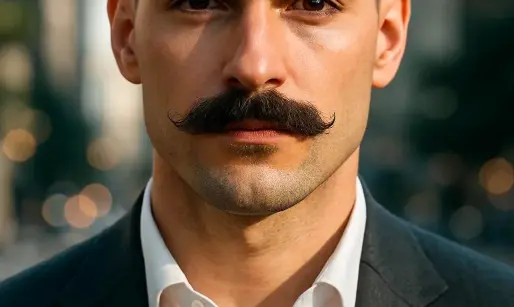
Chevron With Slight Flare
The outer edges are left very slightly longer than the center, without any curling, giving a subtle sense of shape while still reading as a true chevron mustache.
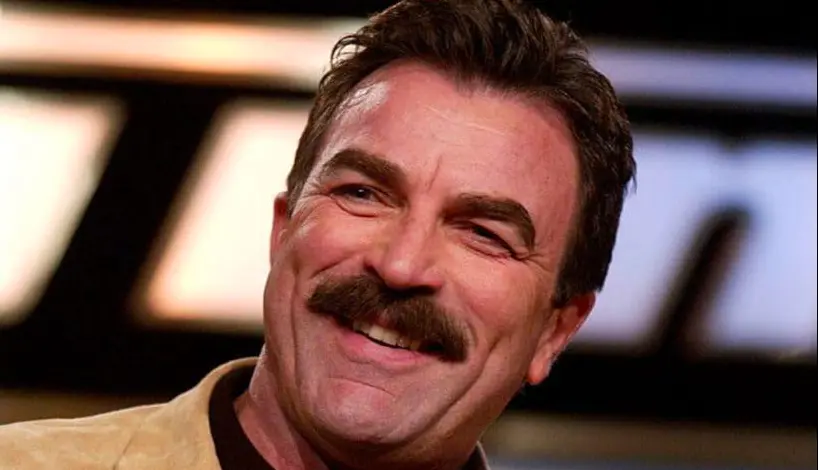
6. Best Face Shapes for This Style
Square and rectangular faces: The width of a chevron mustache complements strong jaw structure without adding bulk lower on the face, since the style stays entirely above the lip. Compare with our best beard for square face guide if you’re deciding between a full beard and mustache-only approach.
Oval faces: Oval faces handle the width of a chevron mustache comfortably since the natural proportions rarely need much visual correction. See best beard for oval face for related comparisons.
Round faces: A chevron can add horizontal width to an already round face, so a short-trimmed version usually looks more balanced than the wider classic style. Details in our best beard for round face guide.
Long or oblong faces: The horizontal emphasis of a chevron mustache helps break up a longer face shape, similar to the balancing effect described in our best beard for oblong face page.
Triangle and diamond faces: A chevron mustache adds width at the mid-face, which can help balance narrower foreheads or jawlines. Related reading: best beard for triangle face and best beard for diamond face.
7. Hair Type and Growth Considerations
- Thick, coarse hair: The ideal growth type for this style, since a genuinely thick mustache fills the entire width evenly without visible gaps.
- Fine or thin hair: Can struggle here more than with other mustache styles for men, since there’s nothing in the shape to disguise sparse patches.
- Patchy mustache growth: If your mustache comes in unevenly, particularly near the corners of the mouth, a chevron will highlight that rather than hide it. Our patchy beard guide covers ways to work with uneven growth more broadly.
- Curly or wavy mustache hair: Generally not a problem for this style, since the chevron doesn’t rely on straight lines or curled ends the way a handlebar does.
8. How to Grow a Chevron Mustache
Step 1 — Stop trimming completely for three to four weeks. The chevron needs consistent length across the whole width, so resist any shaping during this early growth window.
Step 2 — Watch how density fills in near the corners. This is usually the last area to catch up with the center, so don’t judge the final shape until you’ve given it a full month.
Step 3 — Trim the length once growth is even, not before. Cutting back early, before the corners have filled in, is the most common reason first attempts at this style look patchy.
Step 4 — Define the bottom edge just above the lip line. Keep the mustache from hanging over your mouth by trimming the bottom edge cleanly, without narrowing the overall width.
Step 5 — Even out the length across the full mustache. Use a guard on a trimmer to bring the whole shape down to a consistent length, checking both sides for symmetry rather than trimming from one side across.
9. How to Trim and Shape It
Trimming a chevron mustache is more about consistency than precision shaping.
- Comb the mustache downward and outward before trimming so you can see true, untangled length.
- Set your trimmer guard to your target length — most chevron mustaches sit between a quarter and half an inch, depending on how bold you want the look.
- Trim from the center outward on each side, checking length against the opposite side as you go rather than finishing one side completely first.
- Clean the bottom edge with scissors or an edge trimmer, keeping it just above the lip line so it doesn’t interfere with eating or speaking.
- Check width symmetry in a mirror, making sure both corners extend the same distance from the center.
Expert tip: Trim slightly less than you think you need to on a first attempt. It’s far easier to go back and take more off than to wait for length to grow back evenly.
10. Maintenance Routine
- Twice weekly: Trim the bottom edge and overall length to keep the shape from drifting into an unstructured mustache.
- Daily: A quick comb to keep hair lying flat and evenly distributed across the width.
- Weekly: Check symmetry under strong, direct light rather than dim bathroom lighting.
- As needed: Clean up any stray hairs growing outside the natural mustache line, particularly near the nose.
For broader facial hair upkeep, our beard care guide and how to trim a beard resources cover skin and tool care that apply here as well.
11. Products Worth Owning
- Trimmer with adjustable guard lengths — for consistent length across the full width.
- Small precision scissors — for the bottom edge and any stray hairs.
- Mustache comb — keeps hair lying flat rather than curling or separating unevenly.
- Light mustache balm — softens coarse hair without weighing it down, useful since this style doesn’t rely on wax.
Skip heavy wax products entirely for a chevron mustache. Because the style stays flat with no curl, wax generally makes it look greasy rather than adding any real styling benefit.
12. Pairing It With a Beard: The Chevron Beard Look
A chevron mustache doesn’t have to stand alone. Paired with a beard, it becomes what’s often referred to as a chevron beard — where the wide, flat mustache stays the visual anchor while the beard around it is kept shorter and less textured so it doesn’t compete for attention.
This combination pairs particularly well with shorter, structured beard styles rather than very full ones. A medium beard styles approach, or something closer to a Bandholz beard if you want more volume, both work with a chevron mustache as long as the mustache itself stays clearly defined and doesn’t blend indistinguishably into the beard.
13. Common Mistakes
- Trimming too early. Cutting back before the corners fill in is the single most common reason a chevron mustache looks patchy rather than full.
- Letting it grow over the lip. Without a clean bottom edge, the style starts interfering with eating and speaking, which looks unintentional rather than styled.
- Applying wax. Since the chevron relies on flat, even density rather than shape, wax usually just makes it look oily.
- Ignoring width symmetry. Uneven corners are more noticeable on a full-width style like this than on narrower mustache shapes.
- Choosing this style with visibly patchy natural growth. The chevron’s simplicity is also its weakness — it has nowhere to hide uneven density.
14. Common Myths
Myth: A chevron mustache requires styling products to look good. The opposite is generally true. Because it stays flat and full, most chevron mustaches actually look worse with heavy product and better with just a comb and regular trimming.
Myth: Only older men can wear a chevron mustache. While it has a strong association with certain decades, the style works across age groups, provided the density and grooming are consistent.
Myth: Trimming your mustache more often makes it grow in thicker. Trimming frequency has no effect on density or thickness — this remains a persistent grooming myth rather than a grooming fact, and it applies to mustaches just as much as beards.
15. Is a Chevron Mustache Workplace-Appropriate?
The short-trimmed and tapered versions read as clean and controlled, making them workable in most professional environments, including client-facing roles. The classic wide chevron carries more visual presence and suits casual, creative, or self-employed settings slightly better than very conservative corporate environments, though it remains one of the more universally accepted full mustache styles for men in professional contexts, since it doesn’t rely on unconventional shaping like curled or waxed ends.
16. Realistic Growth Timeline
| Week | What’s Happening | What to Do |
| Week 1–2 | Uneven growth, corners lagging behind center | Avoid trimming, let it grow undisturbed |
| Week 3–4 | Width starts evening out | Assess density before making any cuts |
| Week 5 | Full width achievable for most hair types | Trim length and define the bottom edge |
| Week 6+ | Full chevron mustache shape established | Maintain with twice-weekly trims |
Growth speed depends on genetics and hair density, so some men reach a full chevron shape by week four while others need six weeks or slightly longer for the corners to catch up.
Final Thoughts
A chevron mustache works because it doesn’t ask for styling skill, only patience and consistent density. There’s no curling technique to master and no wax to fuss with — the entire look comes down to letting it grow in evenly, trimming the length and bottom edge cleanly, and keeping both corners symmetrical. If your natural mustache growth is thick and even, this is one of the more straightforward mustache styles for men to maintain long-term, and one of the few that looks just as deliberate on day one of maintenance as it does six months in.
If you’re deciding how to pair this with a beard, our guides on goatee styles and the mutton chops beard are useful points of comparison.
FAQs
1. What is a chevron mustache? A chevron mustache is a thick, full-width mustache that covers the entire upper lip evenly, with no curling or shaping at the ends, relying on natural density rather than styling technique.
2. Do I need a thick mustache to wear this style? Yes. A chevron mustache depends heavily on even, dense growth across the full width of the lip, since there’s no shaping to disguise thinner patches.
3. How is a chevron mustache different from a handlebar mustache? A chevron stays flat with no curl and needs little daily styling, while a handlebar mustache relies on wax to curl the ends upward and requires ongoing maintenance to hold that shape.
4. How long does it take to grow a full chevron mustache? Most men need four to six weeks of consistent, untrimmed growth before the corners catch up with the center and the width fills in evenly.
5. What face shapes suit a chevron mustache best? Square, oval, oblong, triangle, and diamond face shapes generally suit a chevron mustache well, since the width helps balance different facial proportions.
6. Can I grow a chevron mustache with patchy facial hair? It’s difficult, since the style has no curling or narrowing to hide gaps. A connected style or a different mustache shape usually suits patchy growth better.
7. Should I use wax on a chevron mustache? No. Wax is meant for curling and holding shape, and since a chevron stays flat, wax typically just makes it look greasy rather than improving the style.
8. What’s the difference between a chevron mustache and a walrus mustache? A chevron is generally shorter and neater, while a walrus mustache is longer and often hangs down over the lip rather than staying trimmed close to it.
9. Is a chevron mustache good for professional settings? The short-trimmed and tapered versions work well in most professional environments, while the classic wide version suits casual or creative workplaces slightly better.
10. Can a chevron mustache be paired with a beard? Yes — this combination is often called a chevron beard, where the full mustache stays the visual focus while the beard around it is kept shorter and simpler.
11. What tools do I need to maintain a chevron mustache? A trimmer with adjustable guards, small precision scissors for the bottom edge, and a mustache comb are typically all that’s needed.
12. Does trimming a mustache more often make it grow back thicker? No. Trimming frequency doesn’t affect hair density or thickness — this is a common misconception, not an actual grooming effect.
13. Who is associated with the chevron mustache style historically? The style became closely tied to 1970s and early 1980s culture, worn by several well-known actors and musicians of that era, and has remained a recognizable, wearable look since.
14. What hair type works best for a chevron mustache? Thick, coarse hair works best, since it fills in the full width evenly. Fine or patchy growth tends to expose gaps more easily with this particular style.
15. What’s the most common mistake men make growing a chevron mustache? Trimming too early, before the corners have fully filled in, which is the main reason first attempts at this style often look thinner or more uneven than intended.