 By Beard Style
The goatee gets a bad reputation it doesn’t fully deserve. Mention it to most guys and they picture a thin chin patch from the early 2000s — but modern goatee styles have moved well beyond that. Today’s goatee beard styles range from a tight, barely-there chin patch to a full extended goatee that connects along the jaw, and several variations are some of the most flattering options available for round, oval, and square faces alike.
What makes the goatee genuinely useful, rather than just trendy, is its versatility. It works around patchy cheek growth that would ruin a full beard. It can soften a round face or sharpen a square one, depending on how it’s shaped. And it scales from a low-effort weekend look to a precisely maintained, professional style with the right trimming routine.
In this guide, we’ll cover every major type of goatee, who each one suits, how difficult each is to maintain, and the small details that separate a sharp, intentional goatee from one that looks like an afterthought. By the end, you’ll know:
- The different types of goatee styles and what defines each
- Which goatee style suits your face shape — including the best goatee for a round face
- How to grow and shape a goatee step by step
- The tools and products needed to keep it looking sharp
- Common mistakes and myths that trip up first-time goatee growers
Let’s start with what actually defines a goatee.
Table of Contents
1. What Is a Goatee, Exactly?
A goatee is a style of facial hair grown on the chin, typically with the cheeks kept clean-shaven or closely trimmed. The term covers a wide range of variations — some include a connected mustache, some don’t, and some extend along the jawline while still leaving the cheeks bare.
What separates a goatee from a full beard is simple: the cheeks. Once cheek hair is grown in and connected to the chin and jaw, you’re moving into full beard or extended goatee territory rather than a classic goatee.
Raed More: Beard Care Mistakes That Are Ruining Your Beard (And How to Fix Them)
2. Why the Goatee Works for So Many Face Shapes and Growth Patterns
The goatee earns its long-term popularity for a few practical reasons:
- It hides patchy cheek growth. Many men grow strong chin hair but thin, uneven cheek hair — a goatee sidesteps that issue entirely.
- It’s highly shape-adjustable. A barber can lengthen, widen, or narrow a goatee to balance almost any facial proportion.
- It suits short and long facial hair. Unlike some styles that only work at specific lengths, goatees can be kept tight and short or grown out fuller.
- It’s quick to grow. Most goatee styles look intentional within 3–4 weeks, much faster than full or long beard styles.
That said, a goatee’s biggest advantage — sharp, defined edges — is also what makes maintenance non-negotiable. An overgrown or uneven goatee looks far messier than an overgrown full beard.
Read More About Types of Beard: https://beardstyles.net/types-of-beard-styles/
3. Types of Goatee Styles
Classic Goatee
Hair grown on the chin only, shaped into a small, rounded or slightly pointed patch, with a thin connecting strip to a mustache optional.
Styling difficulty: Low-medium. Maintenance level: Medium — needs regular edging to keep the cheeks clean. Best for: Round and oval faces.

Goatee Without Mustache
Exactly what it sounds like — chin hair only, with the upper lip kept fully shaved. A cleaner, more minimal take on the classic goatee.
Styling difficulty: Low. Maintenance level: Medium — requires consistent shaving of the upper lip to maintain the contrast. Best for: Men who prefer a simpler, less retro look, or whose mustache growth is notably patchier than their chin growth.

Extended Goatee
A goatee connected by a thin line running along the jaw to the sideburns, while the cheeks themselves remain bare or very lightly stubbled.
Styling difficulty: Medium. Maintenance level: Medium-high — the connecting jawline strip needs frequent, precise trimming. Best for: Round and square faces; the horizontal line adds width and structure.
Anchor Goatee
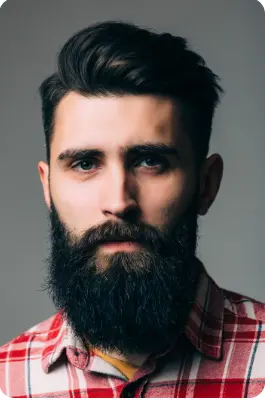
A pointed chin section connected to a mustache and thin jawline strip, shaped to resemble a ship’s anchor. Sharp, defined lines are essential to the look.
Styling difficulty: High. Maintenance level: High — needs frequent edging to maintain crisp lines. Best for: Round and oval faces that benefit from added angularity.
Van Dyke Goatee
A pointed chin beard combined with a disconnected mustache, with the cheeks kept fully shaved. One of the most recognizable goatee variations historically.
Styling difficulty: High. Maintenance level: High — daily shaving of the cheeks is required to maintain the disconnected look. Best for: Diamond and oval faces.

Short Goatee (Chin Puff)
A very small, closely trimmed patch of hair directly under the lower lip and on the chin, often just a few millimeters in length.
Styling difficulty: Low. Maintenance level: Low-medium — small size means any unevenness is highly visible, so edging needs to be precise even though the area is small. Best for: Men who want a subtle look or are easing into facial hair for the first time.

Modern Goatee (Goatee with Stubble)
A goatee shape layered over light stubble across the rest of the jaw and cheeks, blending the defined chin shape with a softer overall look.
Styling difficulty: Medium. Maintenance level: Medium — needs regular trimming of both the goatee shape and the surrounding stubble length. Best for: Square and oval faces; a popular modern alternative to the sharply lined classic goatee.

Horseshoe Goatee
A goatee combined with a thick mustache extending down both sides to the jawline, forming an upside-down horseshoe shape around the mouth and chin.
Styling difficulty: Medium-high. Maintenance level: High — bold, thick lines require consistent upkeep. Best for: Square and oval faces with strong jawlines; less suited to conservative workplaces due to its bold, retro appearance.
Read More About Short Bread Styes: https://beardstyles.net/short-beard-styles/
4. Goatee Styles by Face Shape
| Face Shape | Best Goatee Styles | Why It Works |
| Round | Extended goatee, anchor goatee | Adds length and angularity, breaking up roundness |
| Square | Modern goatee with stubble, horseshoe goatee | Softens or complements strong jaw angles depending on shape |
| Oval | Classic goatee, Van Dyke goatee | Naturally balanced shape suits most goatee variations |
| Long/Narrow | Short goatee, goatee without mustache | Avoids adding further visual length to the face |
| Diamond | Van Dyke goatee | Balances a narrow chin and forehead |
| Heart | Extended goatee | Adds width along a narrower jawline |
A skilled barber will adjust width and length slightly based on your individual bone structure rather than following the chart exactly.
5. Best Goatee for a Round Face
Round faces benefit most from goatee styles that add visual length and break up the natural curve of the jaw and cheeks. The two strongest options are:
Extended Goatee
The thin jawline connection draws a defined line where a round face otherwise lacks one, creating the impression of a more structured jaw without requiring a full beard.
Anchor Goatee
The pointed chin section adds length below the jaw, while the angular lines along the jaw counteract the soft curves typical of a round face shape.
Barber tip for round faces: Keep the cheek line slightly higher than you might expect and the chin point slightly more defined — both choices add the illusion of length that a round face benefits from.
What to avoid on a round face: Very short, small goatees like the chin puff, which can get visually “lost” on a fuller face and fail to add the structure a round face needs.
Raed More: Beard Care Mistakes That Are Ruining Your Beard (And How to Fix Them)
6. Goatee Styles by Hair Type
Thick, Coarse Hair
Holds shape well in almost any goatee styles, including the anchor goatee and Van Dyke, where crisp lines matter most.
Fine, Straight Hair
Can look sparse in styles requiring sharp definition, like the Van Dyke. A modern goatee with surrounding stubble often reads as fuller and more intentional on fine hair.
Curly or Coily Hair
Naturally adds density, which suits the classic goatee and extended goatee well. Watch for ingrown hairs along the jawline edge, which are more common with curly facial hair, especially right after trimming.
Patchy Growth (Cheek-Specific)
This is precisely the situation the goatee was made for. If your cheek hair grows in thin or uneven but your chin growth is solid, almost any goatee styles will look better than attempting a full beard.
Read More About Long Bread Styes: https://beardstyles.net/long-beard-styles/
7. How to Grow and Shape a Goatee
- Let everything grow for 2–3 weeks. Don’t shave anything yet — you need to see your natural growth pattern on the chin, cheeks, and upper lip.
- Identify your strongest growth zone. Most men have noticeably better chin growth than cheek growth, which is exactly what a goatee is designed around.
- Mark your lines before trimming. Use a barber’s pencil or simply identify the natural edge where you want the goatee to stop along the jaw and cheeks.
- Shave the cheeks and neck first. Removing the surrounding hair makes the goatee shape immediately clearer and easier to refine.
- Trim the goatee itself to your desired length. Start longer than you think you want — it’s easier to go shorter afterward than to fix an overly short trim.
- Clean up edges with a detail trimmer or razor. Sharp, straight lines are what separate a well-groomed goatee from an unintentional-looking patch.
Realistic expectation: Most goatee styles look fully shaped and intentional within 3–4 weeks, faster than nearly any other beard style on this site.
8. How to Maintain a Goatee
Goatees need frequent touch-ups because the surrounding skin is shaved bare — any regrowth on the cheeks or neck is immediately obvious.
Daily Routine
- Check the cheek and neck area each morning; goatees show stray stubble faster than fuller beard styles
- Apply a small amount of beard oil to the chin hair to keep it soft and reduce itchiness
- Comb the chin hair into shape, especially for longer goatee variations
Every 2–3 Days
- Shave the cheeks and neck to maintain the clean contrast that defines the goatee
- Touch up the jawline strip on extended or anchor goatee styles
Weekly
- Trim the goatee itself to maintain consistent length
- Reassess and adjust the shape slightly if the natural growth pattern has shifted
Skin Care
Daily shaving around a goatee can cause irritation, razor bumps, or ingrown hairs, particularly with curly facial hair. A good pre-shave routine — warm water, a quality shaving cream, and shaving with the grain — significantly reduces this risk.
9. Tools You Need for Goatee Maintenance
- Detail trimmer or edger — essential for the precise lines a goatee depends on
- Razor — for keeping the cheeks and neck completely clean between goatee touch-ups
- Beard comb — keeps chin hair trained and neat, especially on longer goatee styles
- Beard oil — softens chin hair and reduces itchiness, especially important since goatee hair is often left slightly longer than surrounding stubble
- Shaving cream or gel — reduces irritation on the shaved cheek and neck areas
- Aftershave or soothing balm — helps calm skin after shaving close to the goatee’s edges
10. Goatee vs Full Beard: Which Should You Choose?
| Factor | Goatee | Full Beard |
| Growth time | 3–4 weeks | 2–4 months |
| Daily maintenance | Medium-high (frequent shaving needed) | Medium |
| Hides patchy cheeks | Yes, very effectively | Less effectively |
| Styling precision needed | High | Moderate |
| Workplace acceptance | Generally high | Moderate, industry-dependent |
| Best for first-time growers with patchy cheeks | Yes | Only with patience |
Bottom line: If your cheek growth is noticeably weaker than your chin growth, a goatee styles will almost always look more polished and intentional than pushing through a patchy full beard phase.
11. Professional and Workplace-Friendly Goatee Styles
For client-facing roles and conservative workplaces, barbers typically recommend:
- Classic goatee — neat, recognizable, and broadly accepted
- Short goatee (chin puff) — subtle and low-profile
- Goatee without mustache — clean and minimal
Professional barber advice: Keep the goatee tight to the chin, avoid excessive length, and maintain a sharply shaved cheek and neck area. Precision reads as professional far more than size or boldness.
12. Common Mistakes With Goatee Styles
- Letting the cheek stubble grow between shaves — undermines the entire point of the goatee’s clean contrast
- Uneven jawline connection on extended goatees — a wavy or inconsistent line looks far worse than a straight one
- Trimming the goatee too short, too often — can make the chin area look thin or patchy over time
- Skipping pre-shave prep — leads to irritation and ingrown hairs around the goatee’s edges
- Ignoring symmetry — a goatee slightly off-center is much more noticeable than asymmetry in a full beard
- Choosing a style that doesn’t match growth pattern — forcing an anchor goatee onto patchy jawline growth instead of choosing a more forgiving style like the classic goatee
13. Common Myths About Goatees
Myth: Goatees are outdated. Several modern variations, like the goatee with stubble, are widely worn and don’t resemble the dated, thin-strip goatees associated with earlier decades.
Myth: A goatee is the easiest beard style to maintain. It actually requires more frequent shaving of the surrounding area than many other styles, even though the goatee section itself is small.
Myth: Goatees only suit round faces. While particularly effective on round faces, styles like the Van Dyke and classic goatee work well on oval and diamond faces too.
Myth: You need a connected mustache for a “real” goatee. A goatee without a mustache is a legitimate, widely worn style — the mustache is optional, not a requirement.
14. Who Should Avoid a Goatee
A goatee isn’t the ideal choice for everyone. Consider a different style if:
- Your chin growth is notably weaker or patchier than your cheek growth — in that case, a full beard or extended style covering more area may look more intentional
- You’re not willing to shave the cheeks and neck every 2–3 days, since regrowth there undermines the entire look
- You have sensitive skin prone to significant irritation from frequent shaving; in that case, a longer break between touch-ups or a switch to careful trimming rather than razor shaving can help, and persistent irritation is worth discussing with a dermatologist
15. Conclusion
The goatee has earned its staying power for a good reason: few other beard styles work this well around patchy growth while still offering this much room to adjust shape, width, and length to your specific face. Whether you go with a classic goatee, an extended goatee for a round face, or a minimal short goatee for your first time growing facial hair, the key to making any goatee style work is precision — clean lines, consistent shaving of the surrounding skin, and a shape that matches how your hair actually grows in.
Give it three to four weeks to fully come in before judging the shape, invest in a decent detail trimmer, and don’t be afraid to adjust the width slightly until it genuinely complements your face.
FAQ
1. What is the difference between a goatee and a beard? A goatee is facial hair grown specifically on the chin, usually with the cheeks shaved, while a full beard covers the cheeks, jaw, and chin together.
2. What’s the best goatee style for a round face? The extended goatee and anchor goatee both work well on round faces, since they add visual length and angularity.
3. Can you have a goatee without a mustache? Yes — a goatee without a mustache is a common and accepted style, with the chin hair grown independently of the upper lip.
4. How long does it take to grow a goatee? Most goatee styles look fully shaped within 3–4 weeks, faster than most full or long beard styles.
5. Why does my goatee look patchy? Patchiness is usually genetic and related to chin hair density; many goatee styles are specifically chosen because they minimize the visibility of patchy areas elsewhere on the face.
6. How often should I shave around my goatee? Most barbers recommend shaving the cheeks and neck every 2–3 days to maintain a clean, intentional contrast around the goatee shape.
7. What’s the easiest goatee style to maintain? The short goatee, or chin puff, is generally the simplest, since its small size requires less daily shaping, though the surrounding area still needs regular shaving.
8. Is a goatee professional enough for the office? Yes — a classic goatee, short goatee, or goatee without a mustache are generally accepted in most professional and client-facing roles.
9. What’s the difference between an extended goatee and an anchor goatee? An extended goatee connects along the jawline with a simple thin strip, while an anchor goatee includes a pointed chin section and mustache styled to resemble an anchor shape.
10. Do I need beard oil for a goatee? Yes — even a small goatee benefits from beard oil, which softens the hair and reduces itchiness, especially if grown slightly longer than typical stubble.
11. Can a goatee work with patchy cheek growth? Yes — that’s one of the goatee’s biggest advantages, since the cheeks are shaved clean rather than relying on even growth across the entire face.
12. What’s the best goatee style for thin facial hair? A modern goatee blended with light stubble often looks fuller and more intentional on thin or fine facial hair than a sharply defined style like the Van Dyke.
13. How do I keep my goatee lines straight? Use a detail trimmer or edger with a steady hand, work in small sections, and check your work in good lighting from multiple angles before finishing.
14. Why does shaving around my goatee cause irritation? Frequent shaving close to the same area can lead to razor burn or ingrown hairs, particularly with coarse or curly hair; proper pre-shave prep and shaving with the grain help reduce this.
15. What’s the most modern goatee style right now? The goatee with stubble — a defined chin shape blended into light stubble across the rest of the face — is currently one of the most widely worn modern variations.