
 By Bread Styles Team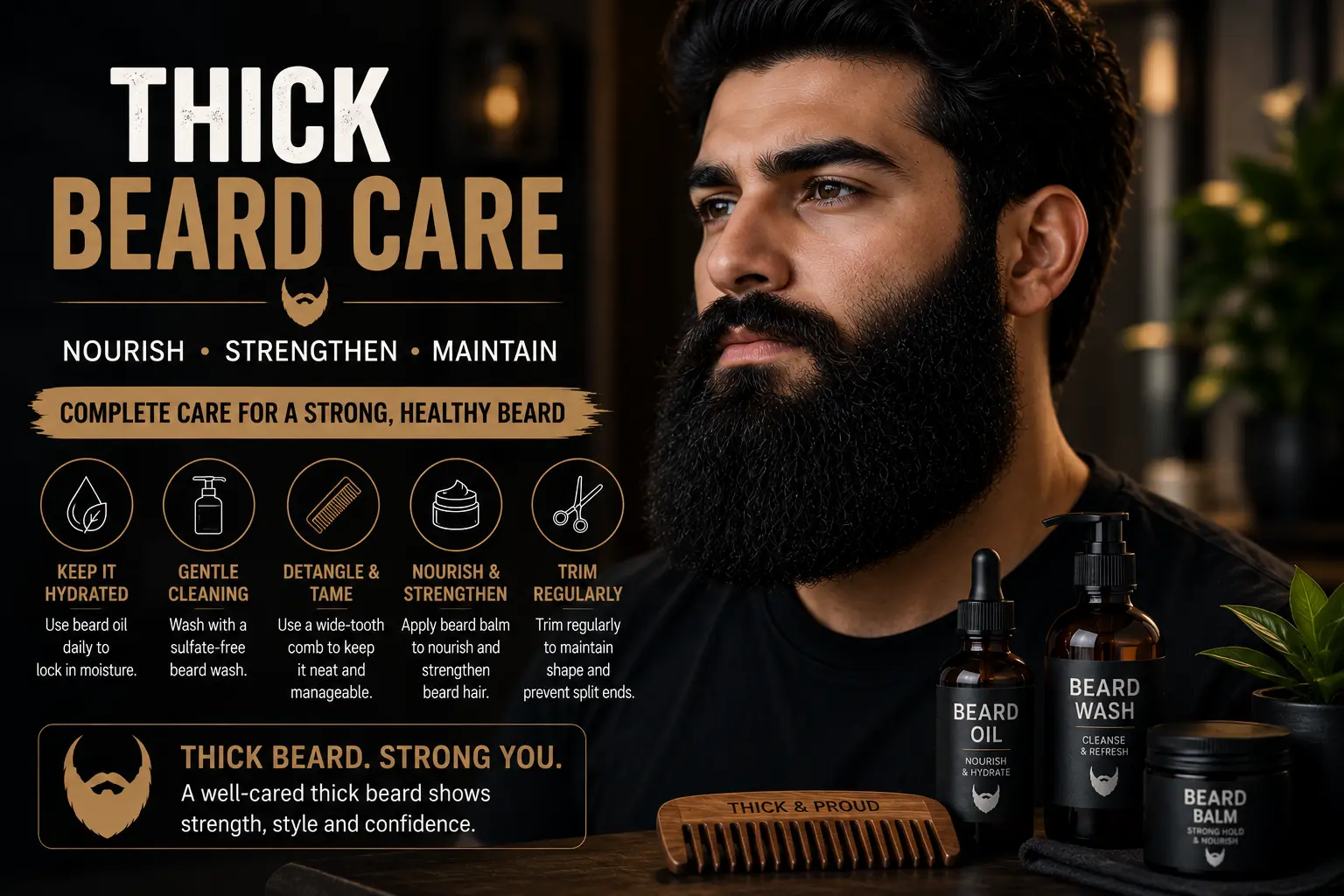
A thick beard gets compliments and complaints in equal measure. It fills in fast, looks powerful once it’s shaped right, and gives you options most guys with sparse growth don’t have. It also traps heat, tangles overnight, itches during the early months, and can look like a mess if you skip even a week of upkeep. Thick beard care is really about controlling all that density with the right routine, not fighting it.
This guide covers what makes a beard “thick” versus just long, the daily habits that keep dense facial hair looking sharp instead of overgrown, and the tools and styles worth your time. It’s written the way a barber would explain it across a few appointments, not as a wall of generic tips.
Table of Contents
What Actually Counts as a Thick Beard
Quick answer: A thick beard refers to facial hair with high density — the number of hairs per square inch of skin — rather than length alone. A man can have a long beard that’s actually thin and patchy, or a short beard that’s extremely dense. True thickness is about coverage and volume, not how far the hair grows.
Genetics decide density more than anything else. Testosterone and DHT sensitivity influence how many follicles are active and how coarse each strand grows, but two brothers can still end up with noticeably different beard density. If you’ve already got a full thick beard coming in, the priority shifts from growth to control — that’s where most of this guide lives.
Why Thick Beards Are Harder to Manage Than People Expect
Men with sparse or patchy growth often assume a dense beard is easier. It isn’t — it’s a different kind of work.
Weight and Shape Control
More hair means more weight pulling the beard downward and outward as it grows. Without regular trimming, a thick beard loses its shape fast, spreading wide at the sides and losing the clean lines that make it look intentional.
Heat and Sweat Retention
Dense facial hair holds heat and moisture against the skin more than lighter growth. This isn’t just uncomfortable — it also creates conditions where bacteria, dry skin, and beard dandruff show up more easily if hygiene slips.
The Itch Phase
Early growth (roughly weeks two through six) is often itchier on thick beards because more hairs are pushing through the skin at once. It settles down, but a lot of men give up right here, before their thick beard care routine has a chance to work.
Tangling and Knots
Dense hair catches on itself more than thin hair does, especially overnight or after workouts. Left unmanaged, this leads to matting that’s genuinely hard to comb out without breaking hair.
Thick, Dense, or Just Long? Knowing the Difference
These terms get used interchangeably, but they call for different care.
| Type | What It Means | Main Challenge | Care Focus |
| Thick / Dense Beard | High number of hairs per area | Bulk, shape control, heat retention | Regular trimming, lightweight conditioning |
| Long Beard | Length without necessarily high density | Split ends, dryness at the tips | Deep conditioning, protective styling |
| Full Thick Beard | High density combined with even coverage | Combines both of the above | Full routine — wash, condition, trim, shape |
| Coarse Beard | Strand texture (thick individual hairs), not volume | Wiry feel, resistance to styling | Softening oils, patience with heat tools |
If your beard checks more than one of these boxes at once, which is common, your routine needs to cover density control and length maintenance together rather than picking one.
Building a Daily Thick Beard Care Routine
This is the core of thick beard maintenance — the daily habits that actually move the needle, done in the right order.
Morning:
- Rinse with warm water (daily full washing isn’t necessary or good for the skin).
- Apply beard oil, focusing first on the skin underneath, then working through the length.
- Comb from root to tip to detangle overnight knots before they set.
- Brush to distribute oil evenly and lay hair in one direction.
Evening:
- Check for food debris or product buildup, especially in the mustache area.
- On wash days (two to three times a week), use a dedicated beard shampoo rather than regular soap or body wash, which strips natural oils too aggressively.
- Apply a leave-in conditioner or beard balm before bed if the beard is past the four-month mark, when dryness at the tips becomes more noticeable.
Weekly:
- Deep condition once a week, especially in colder or drier climates.
- Check the shape at the neckline and cheek line — thick beards grow out of shape faster than thinner ones.
A consistent thick beard care routine beats an expensive one. Skipping oil for a few days on dense facial hair shows up faster than it would on a lighter beard, simply because there’s more hair competing for the same amount of natural moisture.
Tools That Make the Biggest Difference
Not every product on the shelf matters equally for dense facial hair. Here’s what actually earns a spot in a thick beard care routine.
| Tool/Product | Why It Matters for Thick Beards |
| Beard oil | Softens coarse strands and calms frizz caused by high density |
| Beard balm or butter | Adds hold and helps train bulk to lie in one direction |
| Wide-tooth comb | Detangles without snapping hair, which fine combs tend to do on dense growth |
| Boar bristle brush | Distributes oil evenly through thick volume and helps train direction |
| Sulfate-free shampoo | Cleans without stripping the extra oil a full beard needs |
| Beard scissors or a quality trimmer | Essential for regular shape maintenance — thick beards lose their line faster |
| Leave-in conditioner | Reduces the tangling and knotting dense hair is prone to |
A wide-tooth comb specifically matters more here than most guides mention — fine combs are built for thinner, straighter hair and will pull and break coarse or dense strands rather than glide through them.
Shaping a Thick Beard: Styles That Actually Work
Density gives you room to work with shapes that thinner beards can’t pull off cleanly.
- A Bandholz beard relies on natural fullness and works especially well with high-density growth, since there’s enough hair to fill it out evenly.
- A Garibaldi beard, rounded and full, is practically made for dense facial hair — it needs volume to hold its shape.
- For a sharper, more tailored look, a corporate beard keeps the density but adds cleaner lines at the neck and cheeks, which suits office or client-facing roles.
- Men who want the bulk without the full spread can look at medium beard styles, which manage thick growth at a shorter, more controlled length.
- If you’re drawn to bold, historical shapes, Viking beard styles are built around exactly this kind of dense, substantial growth.
Face shape still matters even with a full beard. Rounder faces generally do better with more length and less width at the sides — the best beard for round face guide breaks this down — while square faces can usually handle a fuller, boxier shape without it looking heavy, covered in the best beard for square face guide. For a wider view of what’s out there before settling on a shape, the types of beard styles overview and dedicated thick beard styles page are both worth a look.
Taming Bulk and Frizz Without Losing Volume
The goal isn’t to flatten a thick beard — that just fights the texture that makes it look full in the first place. It’s about controlling frizz while keeping shape.
- Comb while slightly damp, not soaking wet. This trains direction without the frizz that comes from combing bone-dry hair.
- Use balm over oil alone if the beard puffs out during the day — balm’s slight hold keeps volume from turning into shapelessness.
- Blow-dry on low heat with a comb if you want a smoother finish for a specific occasion, moving the airflow downward in the direction you want the hair to sit.
- Trim width before length. Most “messy” thick beards aren’t actually too long — they’re too wide at the sides and need cheek line cleanup more than an overall cut.
- Sleep on a silk or satin pillowcase if tangling overnight is a recurring issue. It reduces friction compared to cotton.
If your beard leans curly on top of being dense, pair this with a proper curly beard care routine, since curl adds another layer of tangling on top of volume. Beards that grow in straighter but still thick benefit from the lighter, more frequent combing described in a typical straight beard care routine.
Common Thick Beard Maintenance Mistakes
- Over-washing — daily shampooing strips the oil a dense beard actually needs, making it drier and frizzier.
- Skipping the trim because “it’s already full” — thickness hides shape problems for a while, then they become obvious all at once.
- Using head hair products — shampoos and conditioners made for scalp hair aren’t formulated for coarser facial hair or the skin underneath it.
- Brushing dry, tangled hair aggressively — this breaks strands instead of detangling them; comb first, then brush.
- Ignoring the skin underneath — a thick beard hides irritation, ingrown hairs, and dryness longer than a thin one, so problems go unnoticed until they’re worse.
- Choosing a style that ignores face shape — a wide, full spread doesn’t suit every jawline just because there’s enough hair to grow it.
Thick Beard Care Through Different Life Stages
A thick beard care routine isn’t static — what your beard needs shifts with age and how long you’ve had it.
Teenagers and early 20s: Growth is often patchy even with good density potential. Patience matters more than product here — check beard styles for teenagers for realistic expectations during this stage.
30s: This is usually peak density for most men, and the stage where a proper shaping routine pays off the most.
40s and beyond: Beards often thicken further but may start greying unevenly. Coarser, greying hair tends to be drier, so conditioning becomes more important. Beard styles for men over 40 and grey beard styles both cover this transition well, and a salt and pepper beard often looks best kept slightly shorter and better conditioned than it did in solid dark tones.
50s and older: Density can remain strong, but skin sensitivity increases, so gentler products and less frequent heat styling are usually the better call, as outlined in beard styles for men over 50.
A Practical Maintenance Schedule
| Task | Frequency |
| Beard oil | Daily |
| Combing | Daily (morning and evening) |
| Brushing | Daily |
| Beard wash | 2–3 times per week |
| Deep conditioning | Weekly |
| Trim and line-up | Every 2–3 weeks (thick beards drift out of shape faster) |
| Full professional shape-up | Every 4–6 weeks |
Dense beards generally need trims slightly more often than thinner ones, simply because bulk makes an uneven line noticeable sooner.
Myths About Thick Beards
“Thick beards don’t need oil.” They need it more than most, since there’s more hair competing for the skin’s natural oil supply.
“A full thick beard means you don’t need to trim.” Thickness hides shape loss temporarily — it doesn’t prevent it.
“Dense facial hair means poor hygiene underneath is fine.” The opposite is true. More hair traps more sweat, dead skin, and product residue, so hygiene actually matters more.
“You can’t have a thick beard with sensitive skin.” You can — it just means choosing gentler, fragrance-free products and avoiding daily heat styling.
“All thick beards are coarse.” Density (how many hairs) and coarseness (how thick each strand is) are different traits. Plenty of dense beards are actually soft.
When to See a Barber or Dermatologist
A skilled barber can save a thick beard care routine a lot of trial and error — professional shaping every four to six weeks keeps density looking intentional rather than overgrown, and a barber will usually spot skin issues hiding under the hair before you notice them yourself.
See a dermatologist if you notice persistent redness, painful ingrown hairs, patchy hair loss within an otherwise dense beard, or itching and flaking that doesn’t improve with basic hygiene changes. The American Academy of Dermatology publishes reliable, non-commercial information on beard-related skin conditions if you want guidance beyond what a barber can offer.
Final Thoughts
A full thick beard is one of the more rewarding beards to grow, but it rewards consistency more than any single product. Keep the skin underneath clean, condition daily, trim before the shape drifts, and choose a style that actually suits your face rather than just filling out because you can. Thick beard care isn’t complicated — it’s just easy to underestimate how much a dense beard needs compared to a thinner one.
FAQs
1. What is the best thick beard care routine for beginners? Start with daily beard oil, a wide-tooth comb for detangling, washing two to three times a week with a dedicated beard shampoo, and a trim every two to three weeks once the beard is long enough to shape.
2. How do I stop my thick beard from looking messy? Most “messy” thick beards actually have a shape problem, not a length problem. Regular trimming at the neckline and cheek line, along with daily combing in one direction, usually fixes it faster than adding more product.
3. Do thick beards need more oil than thin beards? Yes. Dense facial hair has more strands competing for the same natural oil supply from the skin, so it typically needs slightly more conditioning to avoid dryness and frizz.
4. How often should I trim a full thick beard? Every two to three weeks for general shape maintenance, with a full professional shape-up every four to six weeks. Thick beards lose their line faster than thinner ones as they grow.
5. Why is my thick beard so itchy? Itching is most common in the early growth stage, roughly weeks two through six, when a high number of new hairs are pushing through the skin at once. It typically settles down with consistent moisturizing and doesn’t usually mean anything is wrong.
6. What’s the difference between a thick beard and a dense beard? They’re essentially the same idea described differently — both refer to a high number of hairs per area of skin, as opposed to length, which measures how far the hair has grown.
7. Can a thick beard cause skin problems? It can trap sweat, dead skin, and product buildup more than thinner beards if hygiene routines aren’t kept up, which raises the chance of irritation, ingrown hairs, or beard dandruff. Regular washing and drying properly after washing helps prevent this.
8. What beard styles suit thick, full facial hair best? Bandholz, Garibaldi, and corporate beard styles all work well with high-density growth, since each relies on volume to hold its shape rather than fighting against it.
9. Is a thick beard harder to grow than a normal beard? Growth speed depends mostly on genetics and testosterone sensitivity, not effort. A thick beard isn’t necessarily harder to grow — it’s harder to maintain once it comes in, due to the added bulk and weight.
10. Should I use a straightener on a thick, coarse beard? It’s optional rather than necessary. Coarse, dense hair can be smoothed with low heat and a protectant if a sleeker look is wanted, but daily heat styling isn’t required for a healthy, well-shaped thick beard.
11. How do I keep a thick beard soft instead of wiry? Consistent daily oiling, avoiding over-washing, and using a leave-in conditioner a few times a week all help keep coarse or dense hair softer over time.
12. What’s the best comb for a thick beard? A wide-tooth comb is generally better than a fine-tooth one for dense facial hair, since it detangles without snapping strands the way finer teeth tend to on thicker growth.
13. Does age affect thick beard maintenance? Yes. Beards often stay dense or thicken further with age but can dry out more, especially once greying begins, so conditioning becomes more important in the 40s and beyond.
14. Can a full thick beard suit every face shape? Not without some shaping. Density gives more styling options, but the width and length should still be adjusted to the jawline and face shape for the most flattering result.
15. How long does it take to see results from a new thick beard care routine? Most men notice softer texture and better manageability within two to three weeks of consistent daily oiling and proper washing, with shape improvements becoming visible after the first couple of trims.