
 By Bread Styles Team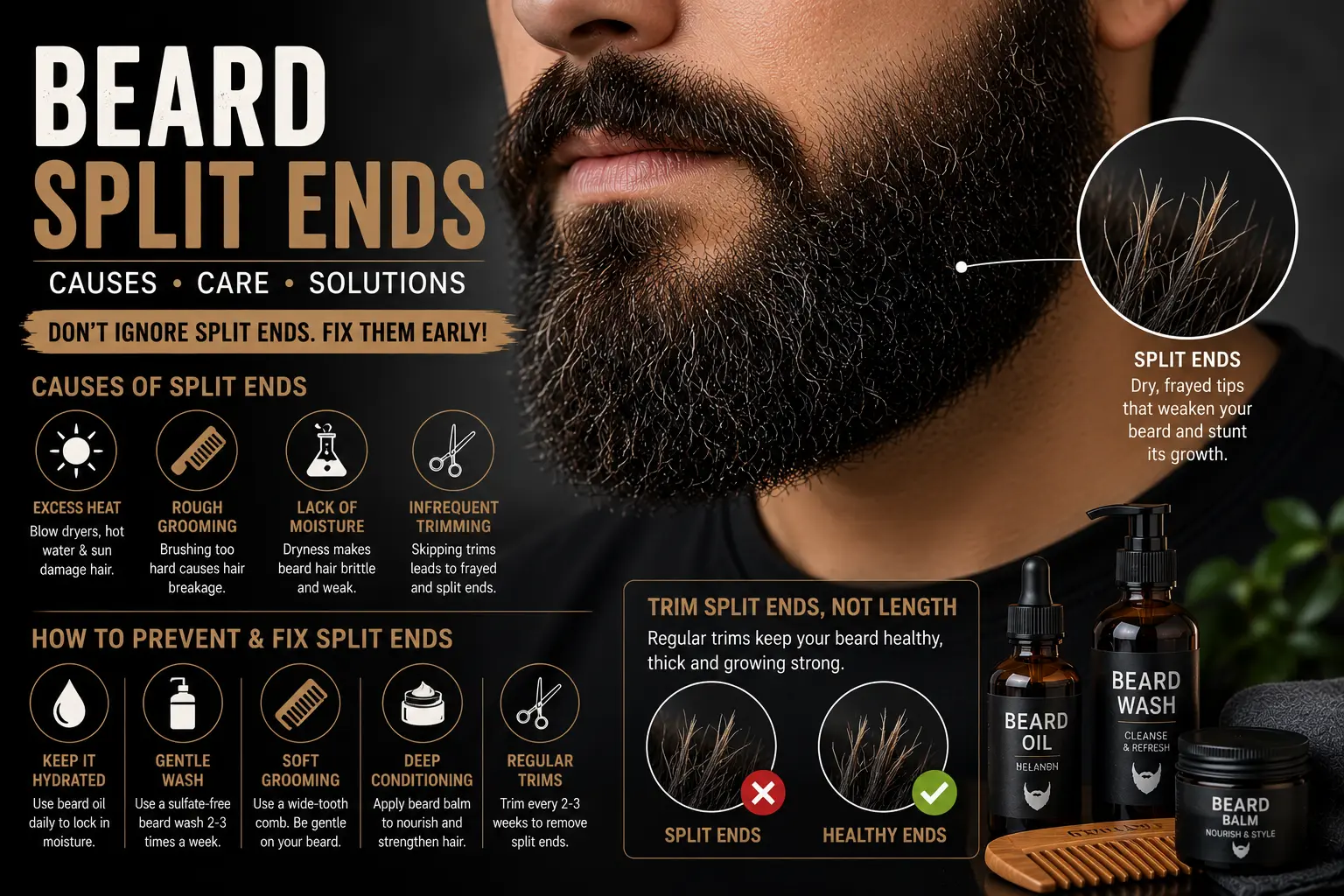
Beard split ends show up quietly. One week your beard looks fine, and a few months later the ends look frayed, dull, and slightly frizzy no matter how much oil you use. This is one of the most common beard damage issues barbers deal with, especially on beards past the four or five month mark, and it’s almost always fixable — just not the way most product ads suggest.
This guide covers what split beard hair actually is, why it happens, and the difference between real repair and temporary cosmetic fixes. There’s a trim technique here too, since cutting the damage out properly matters as much as anything you apply.
Table of Contents
What Beard Split Ends Actually Are
Quick answer: Beard split ends occur when the protective outer layer of a hair strand (the cuticle) wears away at the tip, causing the strand to fray or split into two or more thin pieces. Once a hair splits, the damage doesn’t reverse on its own — it can only be trimmed off or temporarily smoothed with product.
Facial hair is more prone to this than people expect, since it’s coarser than scalp hair in most men and takes more repeated stress from washing, drying, weather, and daily handling over the months it takes to grow to any real length.
How to Tell If You Really Have Split Ends
Not all frizz is split ends, so it’s worth checking before assuming that’s the problem.
Signs you’re dealing with actual split beard hair:
- Individual strands visibly fork or fray at the tip when examined closely
- The beard looks duller and rougher at the ends specifically, not evenly across its length
- Hair tangles more at the bottom third of the beard than near the skin
- Trimmed sections look and feel noticeably smoother than untrimmed length
- The beard feels dry and brittle at the tips even right after applying oil
A quick way to check: pull a few strands gently between two fingers and look closely at the tip under good light. A clean strand ends in a single point. A split strand visibly branches into two or more thin threads.
What Causes Beard Split Ends
Split ends are mechanical and environmental damage building up over time, not one single event.
Heat Styling Without Protection
Straighteners and blow dryers used without a heat protectant are one of the most direct causes of beard damage at the tip, where hair is oldest and already more fragile.
Over-Washing and Harsh Shampoo
Washing daily, or using a scalp shampoo not meant for facial hair, strips natural oils faster than the skin can replace them, leaving the cuticle rough and prone to splitting.
Rough Towel Drying
Rubbing a beard dry with a towel creates friction that roughens the cuticle layer, especially at the ends, which are the most exposed and least protected part of the strand.
Harsh Combs and Brushes
Fine-tooth combs or stiff nylon brushes used on dry hair can snag and tear at weak points, accelerating splitting rather than just detangling.
Weather Exposure
Wind, cold, and prolonged sun exposure all dry out the hair shaft over time, and beard tips take the brunt of it since they’re the oldest, most exposed hair on the face.
Skipping Regular Trims
This is the biggest one. Every strand of facial hair is slightly older and more worn at the tip than the rest of the strand. Without regular trims, that wear compounds for months instead of being removed every few weeks.
Can Split Ends Be Repaired, or Only Cut Off?
Quick answer: Split beard hair cannot be permanently repaired once the strand has actually split — the damage is structural. Conditioning products can temporarily smooth and bind a split strand together, making it look and feel better short-term, but the only real fix is trimming the damaged section off.
This surprises a lot of men because product marketing implies otherwise. Leave-in conditioners, serums, and beard oils genuinely help — they coat the strand and reduce friction, which slows down how fast new splits form. What they can’t do is fuse a hair back into one solid strand once it’s already frayed. Treat conditioning as prevention and damage control, not beard repair in the literal sense.
Split Ends vs Dry, Frizzy Beard Hair
These get confused constantly, and the fix for each is slightly different.
| Symptom | Split Ends | Dry/Frizzy Hair (No Splitting) |
| Where it shows up | Concentrated at the tips | Spread evenly through the beard |
| Feel | Rough, frayed, sometimes thin at the tip | Rough overall, but strands stay intact |
| Fix | Trimming the damaged section | Oil, conditioner, better washing habits |
| Cause | Cumulative mechanical/heat damage | Usually just lack of moisture |
| Does oil alone fix it? | No — temporary smoothing only | Yes, often resolves fully with consistent oiling |
If your beard is rough throughout rather than specifically at the ends, general dryness is more likely the issue than actual split ends, and a dry beard routine focused on moisture will probably solve it without needing a trim.
How to Fix Beard Split Ends Step by Step
- Wash and dry the beard normally so you’re assessing it at its natural state, not weighed down with product.
- Comb through gently with a wide-tooth comb to separate strands without pulling.
- Identify the damaged zone. Split ends are almost always concentrated in the outer one to two centimeters of length.
- Trim just above the visible damage, not the whole length. You’re removing the split section, not starting over.
- Apply a leave-in conditioner or beard oil immediately after trimming to seal moisture into the freshly cut ends.
- Reassess in two to three weeks and repeat trimming only where new splitting has developed.
This isn’t a one-time fix. Beard repair for split ends is an ongoing maintenance habit, the same way scalp hair needs regular dusting to stay healthy at length.
Trimming Technique That Actually Removes Split Ends
Trimming badly can make split ends worse, not better, so technique matters here.
- Use sharp beard scissors, not a razor or dull trimmer. Dull blades crush the hair shaft instead of cutting cleanly, which can cause new splitting right at the cut point.
- Cut small sections at a time rather than grabbing a large chunk of beard at once — this gives you more control over exactly how much length comes off.
- Angle the scissors slightly upward into the hair rather than cutting straight across, which creates a more natural taper and avoids a blunt, uniform edge that highlights any unevenness.
- Check the beard neckline and beard cheek line at the same time — split ends are often noticed alongside a shape that’s grown out and needs cleaning up anyway.
- When in doubt, trim less. You can always remove more next session; you can’t undo an overly short cut.
For a full walkthrough of shaping alongside this, the how to trim a beard guide covers technique in more depth.
Preventing Split Beard Hair Going Forward
Prevention matters more than repair here, since split ends are much easier to avoid than to fix after the fact.
- Apply beard oil daily, focusing on the ends where damage concentrates.
- Wash two to three times a week with a sulfate-free beard shampoo, not daily with regular soap.
- Pat dry instead of rubbing with a towel.
- Use a wide-tooth beard comb instead of a fine-tooth one, especially on damp or coarser hair.
- Apply a heat protectant every time you use a straightener or blow dryer, no exceptions.
- Trim every three to four weeks, even if the beard “looks fine” — prevention trims are shorter and less noticeable than reactive ones.
Products That Support Healthy Beard Ends
| Product | Role in Preventing Split Ends |
| Beard oil | Daily moisture and reduced friction between strands |
| Leave-in conditioner | Extra protection for longer beards prone to more wear at the tip |
| Heat protectant spray | Essential before any heat-styling tool touches the beard |
| Beard serum | Lightweight option for men who find oil too heavy |
| Wide-tooth comb | Detangles without tearing weakened strands |
| Sharp beard scissors | The actual removal tool — no product replaces proper trimming |
None of these single-handedly guarantee healthy beard ends. They work together, and the trim is still the one step nothing else replaces.
Mistakes That Cause Split Ends to Keep Coming Back
- Relying on oil alone and skipping trims entirely. Oil slows damage — it doesn’t remove hair that’s already split.
- Using a dull or cheap trimmer. Cutting hair with a blunt blade crushes the shaft and encourages new splitting at the cut.
- Brushing dry, tangled hair aggressively. This is one of the fastest ways to create new damage on top of existing split ends.
- Over-styling with heat daily. Even with protectant, daily heat exposure adds up faster than facial hair can recover from between washes.
- Ignoring a beard past six months old. Longer beards have more accumulated wear at the tips and need trimming more consistently, not less, as they grow.
Split Ends and Beard Length: What Changes Over Time
The longer a beard grows, the older and more damage-prone its ends become, since that hair has simply been exposed to washing, weather, and handling for longer.
- Short beards (under 1 inch): Split ends are rare here simply because there hasn’t been much time for damage to accumulate.
- Medium beards: This is often where split ends first become noticeable, usually around the three to five month mark.
- Long beards: Require the most consistent trimming and conditioning, since the oldest hair at the tip may be a year or more old and has taken the most cumulative wear. The long beard styles guide covers maintenance expectations specific to length like this.
If you’re maintaining a beard at any real length, pairing this with a general beard maintenance routine keeps split ends from becoming a recurring problem instead of a one-time fix.
When to See a Barber or Dermatologist
A barber is usually the right call for ordinary split ends — a professional trim every four to six weeks catches damage before it spreads and keeps the shape looking intentional. See a dermatologist instead if you notice widespread breakage that isn’t limited to the tips, unusual thinning alongside the splitting, or scalp-like flaking and irritation on the skin underneath, since these can point to something beyond typical mechanical beard damage. The American Academy of Dermatology publishes reliable, non-commercial information on hair and skin health if you want a professional reference point.
A Practical Maintenance Checklist
- [ ] Beard oil applied daily, focused on the ends
- [ ] Washing limited to 2–3 times weekly with a beard-specific shampoo
- [ ] Heat protectant used before any straightening or blow-drying
- [ ] Wide-tooth comb used instead of fine-tooth on damp hair
- [ ] Trim scheduled every 3–4 weeks
- [ ] Towel drying replaced with patting dry
- [ ] Leave-in conditioner used on longer beards
Myths About Beard Split Ends
“Beard oil repairs split ends completely.” It smooths and temporarily binds the strand, but the structural split remains until trimmed off.
“Only long beards get split ends.” Shorter beards are less prone simply due to less accumulated wear, but heat styling or harsh products can still cause damage at any length.
“Trimming makes your beard grow slower.” Trimming affects the dead, already-grown hair shaft, not the follicle, and has no effect on growth rate.
“If it’s not visibly frayed, there’s no damage.” Early-stage splitting can be felt as rough or dry ends before it’s obviously visible, which is why regular check-ins matter.
“Expensive products prevent split ends better than cheap ones.” Consistency of use matters more than price point — a basic oil used daily outperforms a premium one used occasionally.
Final Thoughts
Beard split ends aren’t a sign you’re doing everything wrong — they’re a normal, cumulative result of washing, weather, and time on hair that’s been growing for months. The fix isn’t complicated: trim the damage out on a schedule, protect the ends daily with oil or conditioner, and treat any heat tool with the same caution you’d use on the tips of long scalp hair. Healthy beard ends come from consistency, not from finding the one product that undoes months of wear in a single application.
FAQs
1. What causes beard split ends? Beard split ends are usually caused by heat styling without protection, over-washing, rough towel drying, harsh combing, weather exposure, and skipping regular trims. Damage builds up gradually rather than from one single cause.
2. Can beard split ends be repaired without cutting them? Not permanently. Conditioners and oils can temporarily smooth and bind a split strand, making it look and feel better short-term, but the structural damage only goes away once the split section is trimmed off.
3. How do I know if I have split ends or just a dry beard? Split ends are concentrated specifically at the tips and involve visibly forked or frayed strands, while general dryness affects the whole beard evenly without individual strands splitting apart.
4. How often should I trim my beard to prevent split ends? Every three to four weeks is generally enough to stay ahead of damage before it becomes visible or widespread, even if the beard doesn’t look like it needs cutting yet.
5. Does beard oil actually help with split ends? Yes, as prevention and temporary smoothing. Daily use reduces the friction and dryness that lead to splitting, though it can’t reverse damage that’s already occurred in a strand.
6. Why does my beard get split ends even though I use beard oil daily? Oil alone doesn’t address other causes like heat styling without protectant, rough towel drying, or skipping trims. It needs to be paired with a full routine, not used as a standalone fix.
7. Are split ends more common on long beards? Yes. Hair at the tip of a long beard is older and has been exposed to more washing, weather, and handling over time, which makes split ends more likely to develop the longer a beard grows.
8. What’s the best way to trim split ends at home? Use sharp beard scissors, work in small sections, and trim just above the visibly damaged area rather than cutting the whole length. A wide-tooth comb beforehand helps separate strands cleanly.
9. Can a heat protectant actually prevent beard damage? Yes. Heat protectant spray creates a barrier between the hair and direct heat, significantly reducing the risk of the kind of dryness and breakage that leads to split ends from straighteners or blow dryers.
10. Is it normal for a beard to have some split ends? Some degree of wear at the tips is normal, especially in beards past a few months of growth. It only becomes a bigger issue when trims are skipped and damage accumulates unchecked.
11. Does washing my beard too often cause split ends? Yes, over-washing strips natural oils faster than the skin can replace them, leaving hair drier and more prone to splitting, especially at the ends where the hair is already older and more exposed.
12. What’s the difference between beard damage and normal beard dryness? Beard damage, including split ends, involves actual structural harm to the hair strand, while dryness is a moisture issue that typically resolves with consistent oiling and doesn’t necessarily involve splitting.
13. Should I use a fine-tooth or wide-tooth comb to prevent split ends? A wide-tooth comb is generally better, since it detangles without snagging or tearing at weakened strands the way a fine-tooth comb can, especially on coarser or longer facial hair.
14. Can diet or supplements help prevent beard split ends? General hair health can be supported by adequate nutrition, but split ends are primarily caused by external mechanical and environmental damage, so diet alone won’t prevent them without a proper care routine.
15. How long does it take for beard split ends to grow out completely? Since split hair doesn’t repair itself, the damaged section needs to be trimmed rather than waited out. Regular trims every three to four weeks keep healthy beard ends maintained as the beard continues to grow.