 By Bread Styles Team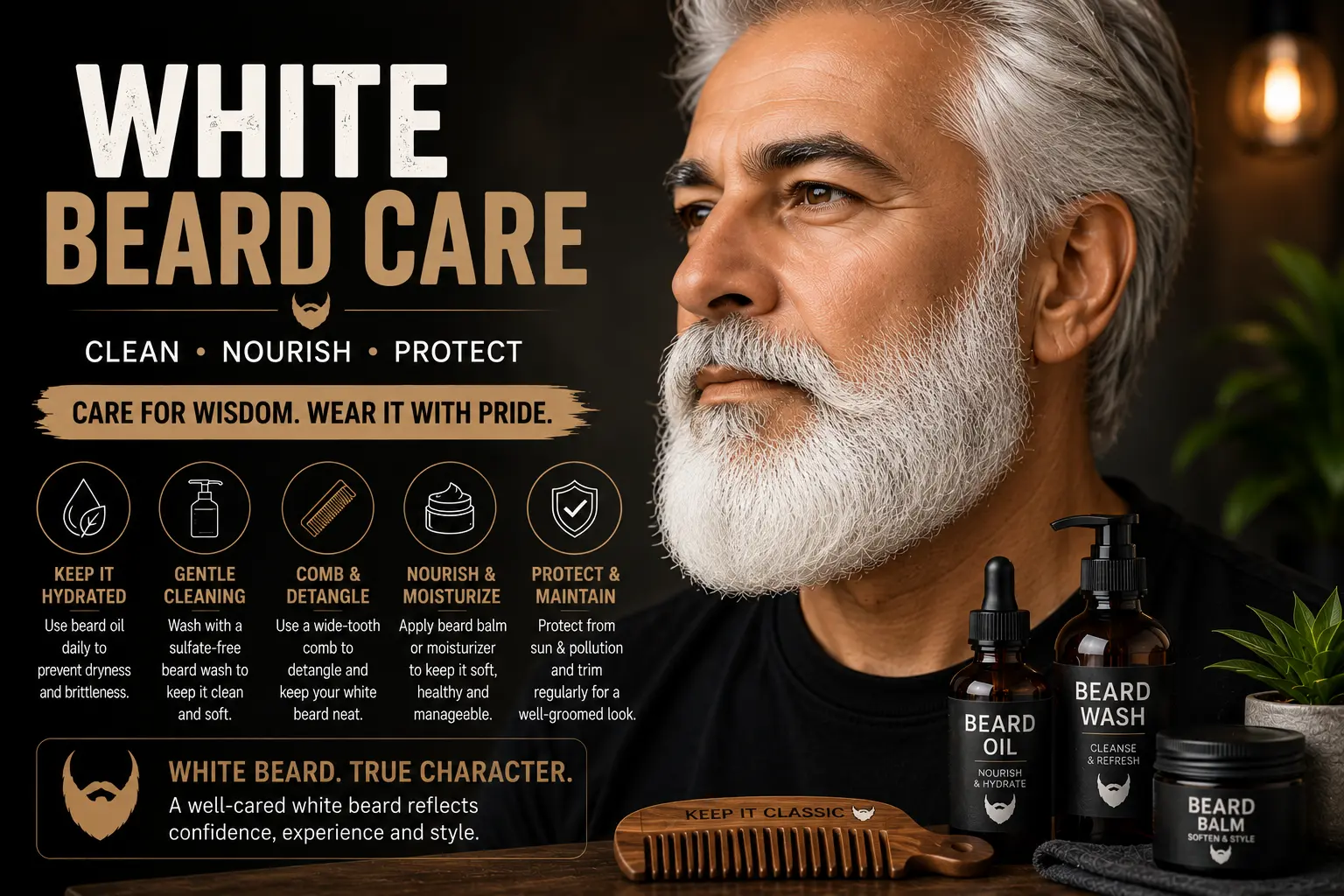
A white beard can look genuinely distinguished — sharp, deliberate, the kind of look younger guys spend money trying to fake with grey dye. It can also look tired and yellowed fast if it’s treated with the same routine you used at thirty. White beard care isn’t just regular grooming with older hair. The hair itself has changed structurally, and the biggest visible problem — yellowing — has causes that darker beards simply don’t deal with.
This guide covers why white and grey hair behaves differently, why it stains yellow in the first place, and the specific routine, products, and styling choices that keep an aging beard looking clean and intentional instead of dull.
Table of Contents
What White Beard Care Actually Focuses On
Quick answer: White beard care refers to grooming practices specifically suited to fully white or heavily greyed facial hair — hair that’s typically coarser, drier, and more prone to yellow staining than pigmented hair. It centers on preventing discoloration, restoring moisture, and using color-safe products instead of a standard grooming routine.
The hair itself isn’t “white” in the way a wall gets painted white. It’s actually hair that has stopped producing melanin, the pigment responsible for color. Without that pigment, the strand reflects light differently, which is also part of why it shows staining and yellowing far more visibly than darker hair does.
Why White and Grey Hair Behaves Differently Than It Used To
Before jumping into products, it helps to understand what’s physically changed.
Loss of Natural Pigment
Melanin doesn’t just give hair color — it also affects the hair’s structure slightly. Once follicles stop producing it, strands tend to grow in coarser and more wiry than the pigmented hair that came before them.
Reduced Natural Oil Production
Sebaceous (oil) glands slow down with age, which means grey and white beards are naturally drier than the same beard was fifteen or twenty years earlier. This dryness is a major reason white beards look dull without regular conditioning.
More Visible Texture Changes
Because there’s no color to distract the eye, texture irregularities — frizz, flyaways, uneven length — show up more obviously on a white or grey beard than they would on a darker one of the same shape.
White, Grey, or Salt and Pepper: Know What You’re Dealing With
These terms often get lumped together, but the right care approach shifts slightly depending on where you are in the process.
| Type | What’s Happening | Main Focus |
| Salt and Pepper | Mixed pigmented and non-pigmented hairs | Even conditioning, avoiding contrast-heavy trims |
| Fully Grey | Hair has lost most pigment but retains a grey tone | Grey beard care with moisture-focused routine |
| Fully White | Hair has lost all pigment entirely | White beard care with strong focus on yellow prevention |
| Yellowing White | White hair that’s picked up discoloration | Purple/blue shampoo and source-of-staining fixes |
If you’re still transitioning rather than fully white, the salt and pepper beard guide covers that in-between stage in more detail, including how to style mixed tones without it looking patchy.
Why White Beards Turn Yellow
This is the question that brings most men to a white beard care routine in the first place, so it deserves a direct answer.
Quick answer: White beards turn yellow mainly from UV exposure, nicotine and smoke residue, hard water minerals, and product buildup from balms, oils, or waxes with yellow-toned ingredients. Because white hair has no pigment to mask discoloration, even mild staining becomes visible fast.
UV Exposure
Sun exposure oxidizes hair proteins over time, and white hair shows the resulting yellow-brown tint far more obviously than pigmented hair does.
Smoking and Nicotine
Nicotine residue is one of the most common and most underestimated causes of yellowing, staining hair around the mouth and mustache area first.
Hard Water Minerals
Iron and other minerals in hard water can deposit on hair over time, leaving a dull, yellowish cast that builds up gradually rather than appearing overnight.
Product Buildup
Some oils, balms, and waxes have a naturally yellow or amber tint. On dark hair this is invisible. On white hair, it tints the strand itself over weeks of daily use.
How to Prevent and Fix Yellow Staining
Yellow beard prevention is mostly about removing the cause, then maintaining with the right products.
- Switch to clear or white-tinted grooming products. Check ingredient color, not just scent — amber-toned oils are common culprits.
- Use a purple or blue-toned shampoo once or twice a week. These use color theory to cancel out yellow tones, the same way they work on bleached scalp hair.
- Filter or soften hard water if it’s a known issue in your area. A simple shower filter can noticeably reduce mineral buildup over a few months.
- Apply a UV-protectant beard oil or balm if you spend significant time outdoors, especially in summer.
- Cut back on staining habits where possible, particularly smoking directly through or near the mustache area.
- Clarify monthly with a deep-cleaning shampoo to strip buildup that regular washing misses.
Existing yellowing usually fades gradually with consistent purple-shampoo use rather than disappearing in one wash — expect visible improvement over two to four weeks of regular treatment, not overnight.
The Daily White Beard Care Routine
Morning:
- Apply a clear or lightly tinted beard oil, focusing on the driest sections first — usually the chin and mustache.
- Comb through gently; white and grey hair is coarser and can tangle more than it looks like it should.
- Use a light balm if styling for the day, choosing color-safe formulas.
Evening:
- Wash 2–3 times weekly with a gentle, color-safe beard shampoo — avoid anything with sulfates, which dry out already-drier white hair further.
- Use a purple or blue-toned wash once weekly as a preventative step, even without visible yellowing yet.
- Apply a leave-in beard conditioner or oil before bed, since white beards typically need more consistent moisture than pigmented ones.
Products Built for White and Grey Beards
| Product | Why It Matters for White Beard Care |
| Purple/blue-toned shampoo | Neutralizes yellow tones directly |
| Clear beard oil | Avoids tinting hair with amber pigments over time |
| Rich beard balm or butter | Combats the added dryness of pigment-free hair |
| Beard moisturizer | Supports the skin underneath, which also tends to dry out with age |
| UV-protectant styling product | Reduces sun-driven yellowing and oxidation |
| Wide-tooth comb | Manages coarser, wirier white hair without snapping strands |
A dedicated beard moisturizer matters more here than in most other beard care routines, since aging skin underneath the beard tends to dry out alongside the hair itself.
Styling a White Beard So It Looks Sharp, Not Untidy
White beards read as either distinguished or unkempt almost entirely based on shape and edge maintenance — the color itself photographs well either way.
- Keep the beard neckline and beard cheek line crisp. Uneven edges are more visible on white hair than dark hair, since there’s no color to soften the transition.
- A well-shaped grey beard styles approach — generally kept slightly shorter than a younger man’s beard — tends to age better and look more deliberate.
- A bandholz beard works well on fully white hair once it’s past the coarse, unruly early stage, since fuller white beards photograph strikingly with clean lines underneath.
- For a more polished, professional setting, a corporate beard trims white or grey growth close and tight, which tends to look sharper on older, coarser hair than a looser shape.
- Consider a shorter overall length if the hair has become notably wirier — the short beard styles guide has options that manage texture better than longer growth does at this stage.
Skin Care for an Aging Beard
The skin underneath an aging beard changes too, and white beard maintenance should account for it.
- Skin becomes thinner and drier with age, so fragrance-free, gentle products reduce irritation risk.
- Sun protection matters more here than people expect — skin under a beard still needs SPF on exposed areas like the neckline and cheeks.
- Ingrown hairs and razor irritation can increase as hair becomes coarser, so a sharp, well-maintained trimmer or blade matters more for an aging beard than it did at 25.
- Regular moisturizing prevents the flaking and dry-skin visibility that stands out clearly against a lighter beard.
Should You Dye a White Beard?
This comes up often enough to deserve a straight answer rather than a sales pitch either way.
Pros: Dyeing can restore a younger appearance quickly, works well for special occasions, and modern beard-specific dyes are formulated to be gentler than scalp hair dye.
Cons: Beard dye needs reapplication every few weeks as new white growth comes in at the roots, can look unnatural if not color-matched carefully, and some men find the maintenance more hassle than the aging beard itself.
There’s no wrong answer here — plenty of men keep their beard fully white and lean into it as a defining look, while others prefer touching up color periodically. If you do dye, patch-test first, since aging skin can react differently to chemical dyes than it did years earlier.
Common White Beard Maintenance Mistakes
- Using the same products from your thirties. Coarser, drier white hair needs more moisture and gentler cleansing than it used to.
- Skipping purple shampoo until yellowing is already obvious. Preventative use is far more effective than trying to reverse heavy staining.
- Ignoring hard water as a cause. Men chase product changes for months without realizing their water supply is the real source of discoloration.
- Over-washing. White and grey beards are naturally drier, so daily shampooing does more harm than good.
- Growing it too long too fast. Coarser texture holds shape less predictably at length, and a gradual approach gives better control over the final look.
- Neglecting the skin. Aging skin under a white beard needs more attention, not less, even though it’s hidden from view.
A Realistic Maintenance Schedule
| Task | Frequency |
| Clear beard oil | Daily |
| Combing | Daily |
| Beard wash (gentle) | 2–3 times per week |
| Purple/blue toning wash | Weekly |
| Deep conditioning | Weekly |
| Clarifying wash (buildup removal) | Monthly |
| Trim and line-up | Every 2–4 weeks |
Myths About White and Grey Beards
“White hair is automatically unhealthy hair.” Not true — it’s simply hair without pigment. Its coarseness comes from structural changes, not damage.
“Nothing can stop yellowing once it starts.” Purple shampoo and removing the source (sun, smoke, hard water, tinted products) reverses most staining over a few weeks.
“Grey and white beard care doesn’t need moisturizing since the hair looks ‘clean’ already.” Colorless hair still needs conditioning — arguably more than pigmented hair, since natural oil production slows with age.
“A white beard limits your styling options.” If anything, white and grey beards read as more distinguished in fuller, classic shapes than the same style would on a younger man.
“Dyeing a beard always looks fake.” Quality, beard-specific dye applied correctly and matched to natural tone can look convincingly natural — poor application is what causes the obvious, flat look people associate with dye.
When to See a Dermatologist
Most white beard care issues, yellowing included, respond to routine changes at home. See a dermatologist if you notice sudden patchy loss within the beard, persistent scalp-like flaking that doesn’t improve with moisturizing, or skin changes like unusual spots or lesions under the beard, which are worth checking given increased sun exposure over a lifetime. The American Academy of Dermatology and British Association of Dermatologists both provide reliable, non-commercial guidance on aging skin and hair changes if you want more detail than a barber can offer.
Final Thoughts
White beard care comes down to two things most men underestimate: how much drier and coarser the hair actually is, and how visible even mild yellowing becomes once pigment is gone. Fix the moisture side with the right products, catch staining early with a toning shampoo, and keep the shape clean, and an aging beard looks deliberate rather than neglected. It’s less maintenance than people assume — it’s just different maintenance than what worked twenty years ago.
FAQs
1. Why does my white beard keep turning yellow? Yellowing usually comes from sun exposure, nicotine residue, hard water minerals, or amber-tinted grooming products. Because white hair has no pigment to mask discoloration, even mild staining shows up clearly.
2. How do I stop my beard from turning yellow? Switch to clear, color-safe products, use a purple or blue-toned shampoo weekly, address hard water if it’s an issue locally, and reduce direct sun and smoke exposure around the beard.
3. Is purple shampoo safe for a white beard? Yes, when used as directed, generally once or twice a week. It’s specifically designed to neutralize yellow tones and is commonly used for this exact purpose on facial and scalp hair.
4. Does white beard hair need different products than a normal beard? Yes. White and grey hair is typically coarser and drier due to reduced natural oil production and pigment loss, so it benefits from richer conditioning and color-safe formulas.
5. What’s the difference between grey beard care and white beard care? Grey beard care applies to hair still holding some pigment, which is usually less prone to visible yellowing, while white beard care focuses more heavily on preventing and correcting discoloration since there’s no color to mask staining.
6. Can I dye my white beard without it looking fake? Yes, with a quality beard-specific dye correctly color-matched to your natural or desired shade. Poor application, not the dye itself, is usually what causes an unnatural, flat look.
7. Why is my white beard so wiry compared to before? Hair that no longer produces melanin tends to grow in coarser and more textured than pigmented hair did previously. This is a structural change, not a sign of damage.
8. Does smoking really cause a beard to turn yellow? Yes, nicotine and smoke residue are among the most common causes of yellowing, typically showing first around the mustache and mouth area.
9. How often should I wash a white or grey beard? Two to three times a week with a gentle, sulfate-free shampoo, since white and grey beards tend to be naturally drier and don’t need daily washing.
10. Can hard water make a white beard look yellow? Yes. Mineral deposits, particularly iron, from hard water can build up on hair over time and create a dull, yellowish tint that develops gradually.
11. What beard styles look best on white or grey hair? Cleaner, well-shaped styles like a tight corporate beard or a fuller bandholz beard tend to look more distinguished on white hair, since sharp lines contrast well against the lighter color.
12. Is a white beard harder to maintain than a darker one? Not harder, just different. It generally needs more moisture and specific yellow-prevention steps, while requiring less concern about color fading from sun exposure than dyed hair would.
13. Should older men use different skin care under a white beard? Yes. Skin tends to get thinner and drier with age, so gentler, fragrance-free products and regular moisturizing help reduce irritation and flaking under an aging beard.
14. How long does it take to fix a yellowed white beard? Most men notice visible improvement within two to four weeks of consistent purple-shampoo use, combined with removing the original source of staining.
15. Does white beard hair grow slower than younger facial hair? Growth rate isn’t necessarily slower due to color change alone, though overall hair growth can naturally slow somewhat with age independent of pigment loss.