 By Bread Styles Team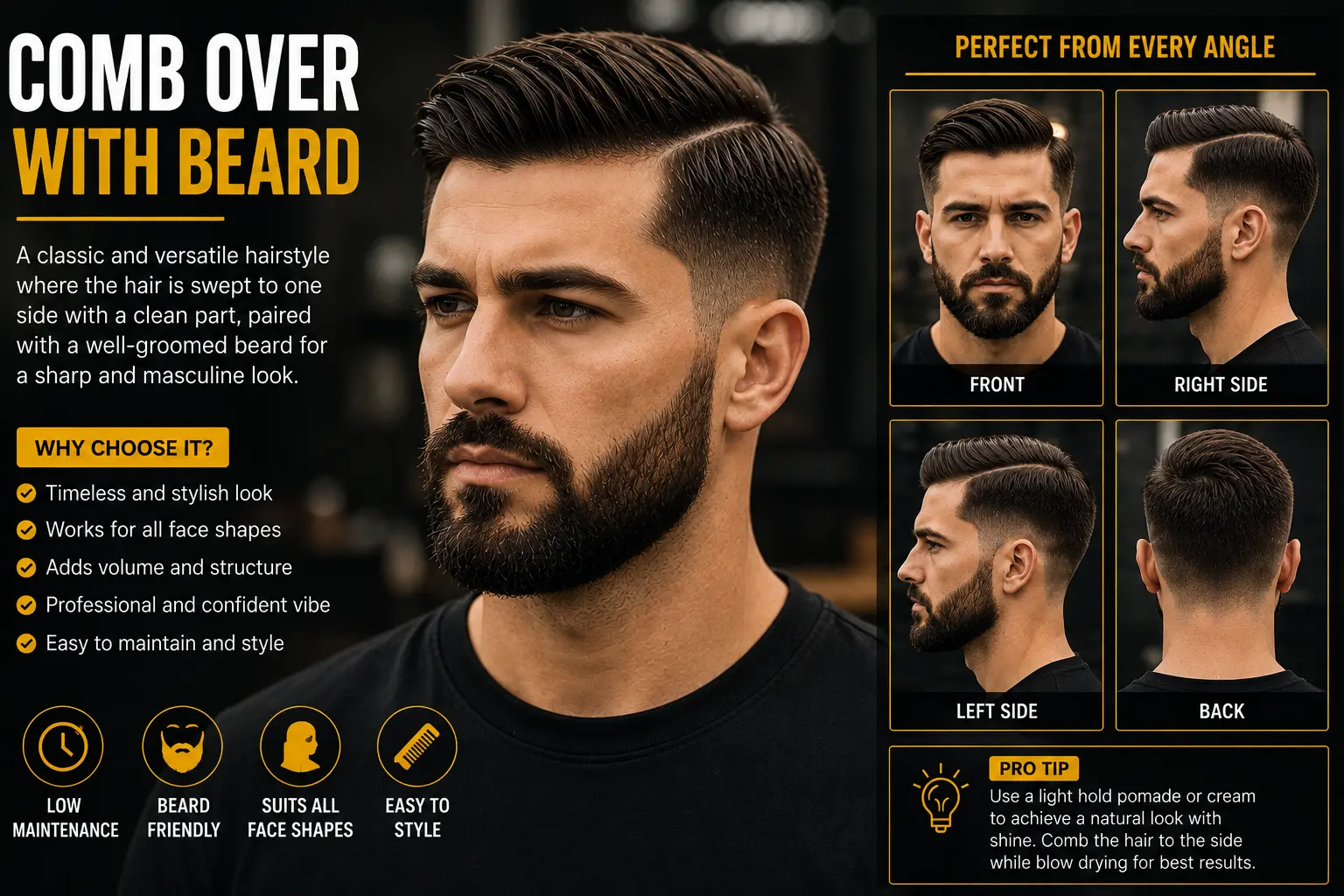
A comb over with beard is a haircut where longer hair on top is swept in one direction, usually over a disconnected or faded section on the sides, and finished with a groomed beard underneath. It’s become one of the more requested modern cuts because it gives noticeably more volume and movement than a side part, without needing hair long enough for a full pompadour.
This guide sorts out the difference between a comb over and a side part, breaks down the most popular comb over fade beard combinations, and covers the styling steps that actually make this cut hold its shape through the day.
A comb over with beard is a haircut with longer hair on top, typically 3 to 5 inches, swept to one side using a blow dryer and product, contrasted against short, faded, or tapered sides, and paired with a trimmed beard. The fade adds sharp contrast, while the beard balances the volume on top.
Table of Contents
Comb Over vs Side Part: Clearing Up the Confusion
These two get mixed up constantly because they share the same basic idea — hair combed from one side to the other. Here’s the real difference.
| Feature | Comb Over | Side Part |
| Hair length on top | Longer, 3–5 inches | Shorter, 2–3.5 inches |
| Volume | High, often blow-dried for lift | Lower, closer to the scalp |
| Sides | Usually faded or disconnected | Tapered, sometimes faded |
| Styling effort | Higher, needs a blow dryer | Moderate, comb and product |
A side part with beard sits closer to the scalp with a defined part line and less overall volume. A comb over pushes for more height and movement, and it’s almost always paired with a fade rather than a simple taper, which is why “comb over fade beard” is searched almost as often as the base term.
Comb Over Fade Beard Pairings
The fade is doing a lot of the visual work in this haircut, so picking the right height matters.
| Fade Type | Contrast Level | Best For |
| Low Fade | Subtle | Conservative, workplace-friendly looks |
| Mid Fade | Balanced | Most versatile option, works for most faces |
| High Fade | Dramatic | Bold, statement styling |
| Skin Fade | Maximum | Sharpest possible contrast against the top |
A low fade with beard keeps things understated and works well in professional settings. A high fade with beard or skin fade with beard pushes the comb over into much bolder territory, with a hard visual break between the long top and the bare sides. Most barbers find a mid fade with beard hits the middle ground that suits the widest range of face shapes and lifestyles.
Disconnected vs Connected Comb Over
Disconnected comb over: The top length has an abrupt, visible jump down to the fade or shaved sides, with no gradual blend. This creates the sharpest, most modern look and tends to pair with a burst fade with beard or skin fade.
Connected comb over: The top blends more gradually into the sides, similar to a standard fade but with more length retained on top for the sweep. This version looks slightly softer and works well for men who want the comb over look without it feeling too aggressive.
Neither version is objectively better — it comes down to how much contrast you want and how much daily styling effort you’re willing to put in, since disconnected versions typically need more precise blow-drying to look intentional rather than accidental.
Best Face Shapes for This Style
| Face Shape | Comb Over Direction | Beard Recommendation |
| Round | Higher volume, swept back for height | Boxed beard with sharp angles to lengthen the face |
| Square | Standard sweep, moderate volume | Short beard or stubble, avoid excess bulk |
| Oval | Most flexible, any version works | Wide range of beard lengths suit it |
| Long | Lower volume, avoid excessive height | Fuller sides, shorter chin length |
| Diamond | Moderate volume, softened at the crown | Fuller jawline beard to balance a narrow chin |
For more detail on matching beard length to face shape, see best beard for round face, best beard for square face, and best beard for diamond face.
Beard Styles That Work Best
Because a comb over already carries a fair amount of visual weight with its volume and fade, the beard generally works best when it stays structured rather than competing for attention.
- Short beard — the most common pairing, giving definition without overwhelming the haircut. See short beard styles.
- Stubble — suits the more casual, disconnected versions of the comb over. Full guide at stubble beard.
- Corporate beard — a strong choice when the comb over is paired with a low fade for office settings. Covered in corporate beard.
- Medium beard — works with the connected, softer version of the comb over, since both have a bit more natural volume. See medium beard styles.
A very full, long beard tends to pull the eye away from the fade and volume on top, so if you want to grow a fuller beard, a lower-contrast haircut usually balances better than a sharp comb over fade.
How to Blow-Dry and Style a Comb Over
This is the step most people skip, and it’s the one that separates a flat comb over from one with real shape.
- Towel-dry hair to about 70%. Slightly damp hair holds a blow-dry style better than soaking wet hair.
- Apply a volumizing spray or light mousse at the roots. This gives the blow dryer something to work with.
- Use a round brush or paddle brush while blow-drying. Lift hair at the roots in the direction you want it to fall, working from the back of the crown forward.
- Direct the airflow down the hair shaft, not against it. This keeps the cuticle smooth and avoids frizz.
- Once dry, apply a small amount of clay or paste. Work it through to define the sweep and add texture without flattening the volume you just created.
- Finish the beard to match. A quick pass with a beard comb keeps everything looking coordinated.
Skipping the blow-dry step and just combing product through damp hair will still work, but it produces noticeably less volume and a flatter finish overall.
Hair Type Considerations
| Hair Type | Fit for a Comb Over |
| Straight | Needs a blow-dry and product to hold volume; falls flat without it |
| Wavy | Excellent natural fit, holds shape with less effort |
| Curly | Works with a slightly longer length; check the curly beard care guide if the beard is curly too |
| Thick | Handles the volume and sweep especially well |
| Fine | Needs a lightweight volumizing product to avoid looking thin against the fade |
How to Ask Your Barber for It
- Ask for 3 to 5 inches of length left on top, swept to one side, with the sides faded or tapered.
- Specify the fade height: low, mid, high, or skin.
- Say whether you want a disconnected or connected transition between the top and the sides.
- Ask for the beard to be shaped in the same visit for a coordinated finish.
- If you’re new to blow-drying your own hair, ask your barber to show you the direction and technique they used, so you can recreate it at home.
Maintenance Routine
Hair:
- Trim every 3–4 weeks to keep the fade sharp, since fades grow out faster than tapers
- Blow-dry with product most days for the fullest version of the style
- On low-effort days, a light clay applied to damp hair and combed over still looks presentable
Beard:
- Trim every 1–2 weeks with a good beard trimmer to keep pace with the sharper haircut
- Apply beard oil daily to prevent dryness
- Wash with a proper beard wash instead of regular shampoo
- Maintain the beard neckline and beard cheek line weekly
The beard care guide has a full routine breakdown if you’re setting this up from scratch.
Suitable for Work and Formal Occasions
A comb over with beard, especially paired with a low or mid fade, works well in most professional environments and reads as more contemporary than a traditional side part. It fits comfortably alongside other office beard styles, though a high or skin fade version leans more toward creative industries and casual workplaces than conservative corporate settings.
For weddings or formal events, get the haircut done 3–4 days ahead so the fade has time to settle, and practice the blow-dry technique once or twice beforehand so the style looks natural rather than freshly done in photos. The wedding beard styles guide has more timing advice.
Best Age Groups
- Teens and 20s: Where this style is most popular, often with a disconnected fade and stubble, since it’s bold and photographs well.
- 30s and 40s: Usually a slightly more conservative version, a connected comb over with a low or mid fade, paired with a fuller short beard for a polished look.
- 50s and beyond: Works well with a softer, lower-volume version, particularly alongside greying facial hair. The beard styles for men over 50 guide has specific advice for this pairing.
Common Mistakes
- Skipping the blow-dry. This is the single biggest reason a comb over looks flat instead of full.
- Choosing too high a fade for a conservative workplace. A skin fade can look out of place in more traditional office environments.
- Letting the fade grow out too long. Fades need more frequent trims than tapers to stay sharp.
- Neglecting the beard. A voluminous, styled top next to an ungroomed beard looks unbalanced.
- Using too much product. Overloading with clay or wax weighs the hair down and cancels out the volume built during blow-drying.
Myths About the Comb Over
Myth: A comb over is the same as a side part. They’re related but different — a comb over uses more length and volume, usually with a fade, while a side part sits closer to the scalp with a defined line.
Myth: It only works on thick hair. Fine hair can achieve real volume with the right lightweight volumizing product and proper blow-drying technique.
Myth: It’s too high maintenance for daily wear. Once you know the blow-dry routine, it takes a few minutes, and a lower-effort day with just clay and a comb still looks reasonably put-together.
FAQs
What is a comb over with beard? A comb over with beard is a haircut with longer hair on top, usually 3 to 5 inches, swept to one side over faded or tapered sides, paired with a groomed beard for a modern, structured look.
What’s the difference between a comb over and a side part? A comb over uses more length and volume, typically finished with a blow dryer, while a side part sits closer to the scalp with a more defined, understated part line.
What is a comb over fade beard style? It refers to pairing the comb over haircut with a faded side, ranging from a subtle low fade to a dramatic skin fade, combined with a trimmed beard.
Is a comb over with beard high maintenance? It’s moderate to high maintenance since it benefits from daily blow-drying for full volume, though a quicker version with clay and a comb works on lower-effort days.
What beard length works best with a comb over? Short beard or stubble tends to work best, giving definition without competing with the volume and fade on top.
Does a comb over with beard suit round faces? Yes, particularly with extra volume and height at the crown, paired with a beard shaped to add length and angles to the jaw.
What fade should I choose for a comb over fade beard look? A mid fade offers the most versatile balance of contrast and workplace suitability, while a high or skin fade suits bolder, more casual styling.
How do I style a comb over at home? Towel-dry hair, apply a volumizing product, blow-dry with a round brush while lifting at the roots, then finish with a small amount of clay to define the sweep.
Is a comb over with beard suitable for the office? Yes, particularly when paired with a low or mid fade, though a skin fade version tends to suit creative or casual workplaces better than conservative offices.
Does a comb over work with curly hair? Yes, though it generally needs slightly longer length and more product to hold the sweep and prevent the curl pattern from fighting the style.
How often should I trim a comb over with beard? Trim the hair every 3–4 weeks since fades grow out faster than tapers, and the beard every 1–2 weeks to keep it looking coordinated.
What’s the difference between a disconnected and connected comb over? A disconnected comb over has an abrupt jump between the long top and the faded sides, while a connected comb over blends more gradually for a softer transition.
Can teenagers get a comb over with beard? Yes, it’s one of the more popular haircuts among younger men, usually paired with a disconnected fade and light stubble.
Does a comb over suit thinning hair? It can help disguise thinning at the crown by adding volume through blow-drying, though very advanced thinning may need a shorter overall style instead.
How long does hair need to be for a comb over? Generally 3 to 5 inches on top gives enough length to create a proper sweep with real volume and movement.
A comb over with beard delivers more shape and presence than a side part while still staying manageable with the right styling routine. Pick a fade height that matches your workplace and personality, keep the beard trimmed to match the sharpness of the cut, and the blow-dry technique will start feeling automatic after a few tries. For more haircut and beard pairings, the types of beard styles page is a good next stop before your next barber visit.