 By Beard Style
Table of Contents
What Makes a Beard “Thin” (and Why Yours Might Be)
A thin beard usually means one of three things: the hair itself is fine and doesn’t have much visual weight, the follicle density is lower than average across the cheeks and jaw, or growth is uneven enough that light patches show through. None of these are flaws. They’re just how your genetics distributed hair follicles on your face, and they’re largely set by your family line, hormone levels, and age.
If you’re searching for thin beard styles, you’ve probably already noticed that generic “how to grow a beard” advice doesn’t apply to you the same way it does to someone with dense, wiry growth. That’s fine. The goal here isn’t to force your face into a Bandholz-style beard. It’s to find shapes that work with the hair you actually have.
Men with thinner facial hair usually fall into one of these groups:
- Younger men (16–22) whose follicles haven’t fully matured yet
- Men with naturally fine hair texture, often paired with lighter hair color
- Men over 40 experiencing a gradual thinning similar to scalp hair
- Men with patchy density, where some zones grow thick and others stay bare
Knowing which group you’re in changes the advice. A nineteen-year-old with immature follicles will likely see real improvement over the next few years. A thirty-eight-year-old with the same density he’s had since college is working with a more permanent pattern, and styling strategy matters more than waiting it out.
Should You Fight Thin Growth or Style Around It?
Short answer for a featured snippet: No single product reliably transforms thin facial hair into thick facial hair. Genetics set your follicle count, and the smartest approach combines realistic growth support with a beard shape chosen specifically for sparse coverage.
That said, the two approaches aren’t mutually exclusive. You can:
- Give your beard 8–12 weeks of undisturbed growth to see your real pattern
- Support the follicles you have with good sleep, iron and protein intake, and gentle skin care
- Choose a style that’s built for lighter density instead of fighting it
- Revisit longer styles later if density improves with age
Men who try to grow a full Garibaldi or Bandholz on thin genetics usually end up frustrated by month three. The hair that’s there gets long enough to look wispy and uneven, while the gaps stay just as visible, only now they’re framed by longer strands. Shorter, tighter thin beard styles almost always look more intentional and more masculine on sparse growth than long ones do.
The 12 Best Thin Beard Styles to Try
These are the shapes that consistently work well for men with lighter density, based on how barbers actually approach clients with this hair type. Each one either keeps the length short enough that gaps don’t register, or uses a defined edge to create the illusion of density.
1. Light Stubble
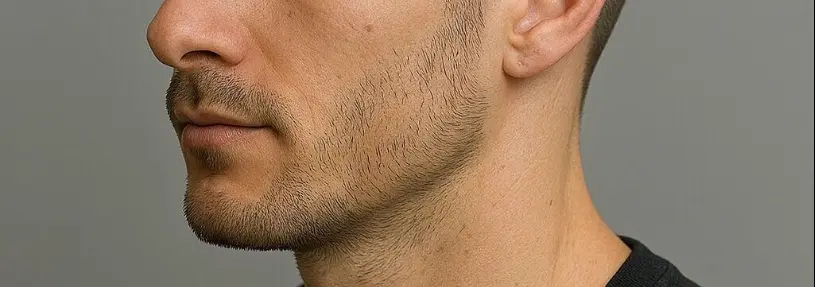
Stubble is the most forgiving option for anyone with thin facial hair. At 1–3mm, individual sparse hairs blend into a shadowed texture instead of standing out as isolated strands. It requires almost no daily styling, just a trim every 3–4 days with a guard. This is a great entry point if you’re still deciding whether to commit to a fuller thin beard style. Our stubble beard guide breaks down exact clipper settings for different stubble lengths.
2. Short Boxed Beard
A boxed beard uses hard, straight lines along the cheek and neck to create structure. Because the edges are crisp, the eye focuses on the shape rather than the density inside it. Keep this one under half an inch. Longer boxed beards on thin growth tend to lose their outline and look shapeless by the end of the day.
3. Corporate Beard
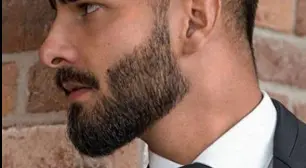
This is a tidy, close, professional beard that barely rises above stubble length but has a defined edge. It’s one of the most reliable corporate beard options for thin facial hair because the short length hides gaps while the clean lines signal it’s a deliberate choice, not a beard you gave up on.

4. Chin Strap With Light Cheek Fill
If your cheeks grow noticeably thinner than your chin and jawline, a chin strap style lets you lean into your strongest growth zone while keeping weaker areas trimmed close. This works especially well for men in their late teens and early twenties whose cheek follicles haven’t caught up yet.
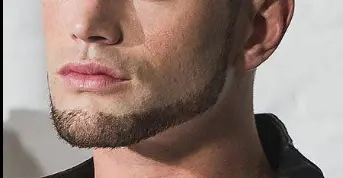
5. Van Dyke
A Van Dyke beard isolates a goatee and mustache, connected but with the cheeks shaved clean. Since it removes the thinnest part of most men’s beards entirely, it’s a smart pick if your cheek density is your main frustration and your chin hair grows in reasonably solid.
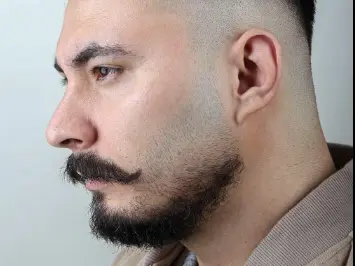
6. Circle Beard
Similar logic to the Van Dyke but rounder and tighter to the mouth. A circle beard is one of the lowest-maintenance thin beard ideas because it covers the smallest surface area, which means less territory for patches to appear.
7. Balbo Beard
A floating mustache and chin patch with the cheeks shaved. Because the balbo is intentionally geometric and detached from the cheek line, uneven cheek growth is a non-issue.
8. Extended Goatee
This adds a thin line connecting the mustache to the chin along the jaw, without full cheek coverage. It’s a middle ground between a basic goatee and a full beard, and it photographs well on narrower or angular face shapes.
9. Anchor Beard
An anchor beard follows the jawline with a pointed chin and connects to a mustache, shaped almost like a boat anchor. The strong horizontal lines along the jaw draw attention away from thin cheek patches.
10. Soul Patch With Mustache Combo
For men whose growth is genuinely sparse everywhere except directly under the lower lip, a soul patch paired with a groomed mustache is an honest, clean option rather than trying to force coverage that isn’t there.
11. French Beard
A French beard keeps a thin strip of hair along the jawline and chin with the rest shaved, giving a sharp, minimal outline that suits thin facial hair because it never asks for volume, only a clean edge.
12. Patchy-Friendly Short Full Beard
If your growth is thin but fairly even across the whole face, a short, fully connected beard kept under 10mm can still work, especially with the density-boosting techniques in the next section. This crosses over with our dedicated guide on patchy beard styling, which covers blending techniques in more depth.
| Style | Best For | Maintenance | Growth Time Needed |
| Light Stubble | Any thin beard type | Very Low | 3–5 days |
| Short Boxed Beard | Even, light density | Medium | 3–4 weeks |
| Corporate Beard | Office / professional settings | Low | 2–3 weeks |
| Chin Strap + Light Fill | Strong jaw, weak cheeks | Medium | 3–4 weeks |
| Van Dyke | Weak cheeks, solid chin | Medium | 4–6 weeks |
| Circle Beard | Minimal coverage needed | Low | 3–4 weeks |
| Balbo | Weak cheeks, angular face | Medium | 4–6 weeks |
| Extended Goatee | Narrow or oval faces | Medium | 4–5 weeks |
| Anchor Beard | Square or angular jaw | Medium-High | 5–6 weeks |
| Soul Patch + Mustache | Very sparse overall growth | Low | 2–3 weeks |
| French Beard | Minimalist preference | Low-Medium | 4–5 weeks |
| Short Full Beard | Even but light density | Medium | 5–8 weeks |
Thin Beard Styles by Face Shape
Face shape changes which sparse beard styles look proportionate, regardless of density. A style that flatters a round face can overwhelm a narrow one, so match the shape first, then adjust for thin growth using the techniques above.
- Round face: Angular styles like the Van Dyke or anchor beard add definition. Full guide: best beard for round face
- Oval face: Almost any thin beard style works here, but a short boxed beard keeps the natural balance oval faces already have. See best beard for oval face
- Square face: Rounder shapes like the circle beard soften strong jaw angles.
- Diamond face: A chin strap with light fill balances a narrow forehead and chin. More detail here: best beard for diamond face
- Heart-shaped face: Fuller chin coverage, like an extended goatee, balances a wider forehead. See best beard for heart face
- Square jaw, narrow forehead: The French beard or corporate beard keep the look proportional without adding bulk.
Barber Techniques That Make Sparse Facial Hair Look Fuller
Styling matters as much as the style itself when you’re working with thin facial hair. These are techniques barbers actually use on clients with lighter density, not gimmicks.
Keep the length consistent and short. Uneven length is what exposes gaps. A beard trimmed to one uniform length, even a short one, reads as fuller than a longer beard with visible variation.
Trim against the direction of growth occasionally. A very light pass against the grain, done carefully with a sharp trimmer, can add texture and the appearance of volume without cutting the beard shorter overall. This is a technique best done slowly and only on stubble to medium lengths.
Use a beard brush, not just a comb. Boar-bristle brushes lift hair away from the skin and distribute natural oils along the shaft, which makes each strand look slightly thicker and catches more light evenly across the face.
Define sharp edges. A crisp cheek line and neckline pull the eye toward clean geometry instead of the density inside the shape. Our guides on beard cheek line and beard neckline cover exactly where to place these lines for different face shapes.
Fill sparingly with beard-specific fiber powder or tinted gel. These products deposit color and micro-fiber onto the skin between hairs, which visually closes small gaps. They work best under indoor lighting and shouldn’t be relied on as a daily habit, since heavy use looks obvious up close.
Avoid over-conditioning. Heavy balms and oils weigh fine hair down flat against the skin, which actually makes thin patches more visible. Lighter, non-greasy oils applied sparingly keep hair lifted.
Tools and Products Worth Owning
You don’t need a large kit. For thin facial hair, precision matters more than quantity.
- A quality trimmer with 0.5mm precision guards for consistent stubble and clean edges
- A boar-bristle beard brush for lift and shine
- Lightweight beard oil with jojoba or argan base, applied after showering
- A small pair of barber scissors for spot-trimming stray long hairs that stand out against shorter growth
- Tinted beard filler (optional) for events or photos where you want extra visual density
- A skin exfoliant used once or twice weekly to keep follicles clear, which supports healthier growth over time
Full routine and product-pairing advice is covered in our beard care guide, and if you’re still working out the right length and blade settings, how to trim a beard walks through the process step by step.
Mistakes That Make a Thin Beard Look Worse
Most men with sparse growth aren’t doing anything wrong biologically, but a few habits actively work against them.
- Growing it out too long, too fast. Length without density exposes gaps rather than hiding them.
- Skipping edge maintenance. A blurry, undefined line makes any beard look neglected, thin ones especially.
- Ignoring the neckline. An overgrown neck makes a tidy jaw beard look messy from below.
- Using heavy, greasy products. These flatten hair and highlight thin zones instead of lifting them.
- Comparing to unrealistic references. Many online “beard transformation” photos are filtered, backlit, or filled digitally. Compare your progress to your own past photos, not to a stranger’s edited post.
- Not exfoliating. Dead skin buildup can trap growing hairs under the surface, which makes coverage look sparser than it actually is.
- Trimming with dull blades. Dull blades pull and tear hair unevenly, leaving inconsistent length that draws attention to gaps.
Beard Growth: What Genuinely Helps and What’s a Myth
There’s no shortage of products promising to turn thin facial hair thick. Most of that marketing overstates what’s biologically possible, so it’s worth separating fact from hype.
What actually has some support:
- Adequate sleep and lower stress support healthy testosterone and growth cycles
- A diet with enough protein, iron, zinc, and biotin supports keratin production
- Gentle exfoliation keeps follicles clear of buildup
- Not shaving too frequently during the early growth phase gives follicles time to establish rhythm
- Consulting a dermatologist is worthwhile if thinning is sudden, patchy in unusual patterns, or accompanied by scalp hair loss, since this can sometimes point to a treatable underlying cause
What’s mostly myth or unproven for the general population:
- Beard oil making hair grow faster (it improves the health and shine of existing hair, not follicle count)
- Shaving frequently to “thicken” regrowth (this is not supported by dermatological research)
- Supplements claiming dramatic density increases without a documented deficiency
If you want a professional opinion on unusually patchy or sudden thinning, the American Academy of Dermatology and the British Association of Dermatologists both publish reliable, non-commercial guidance on facial hair and skin health, and a dermatologist visit is a reasonable next step if something feels off rather than just naturally light.
A Simple Weekly Maintenance Routine
A consistent routine keeps thin beard styles looking sharp between barber visits.
| Day | Task |
| Daily | Brush beard, apply light oil after shower |
| Every 3–4 days | Trim to maintain uniform length |
| Weekly | Clean and redefine cheek line and neckline |
| Weekly | Exfoliate skin underneath the beard |
| Bi-weekly | Deep condition with a beard balm |
| Monthly | Reassess style choice as length and density change |
FAQs
What is the best beard style for thin facial hair? Short, clean-edged styles like light stubble, a corporate beard, or a Van Dyke tend to work best because they either keep hair too short for gaps to show or isolate the strongest-growing areas.
Can a thin beard ever become thick? Density is largely set by genetics and rarely changes dramatically in adulthood. Some improvement is possible through your early twenties as follicles mature, along with good sleep, diet, and skin care, but a complete transformation from thin to thick isn’t typical.
How long should I let a thin beard grow before judging it? Give it at least 8–12 weeks of uninterrupted growth. Many patchy or sparse patterns fill in partially between weeks four and eight, and judging too early leads to unnecessary shaving.
Does trimming a beard make it grow back thicker? No. Hair that’s trimmed grows back the same thickness it was before cutting. This is one of the most persistent grooming myths.
What’s the difference between a patchy beard and a thin beard? A patchy beard has visible bald or bare zones next to areas of normal density, while a thin beard has lighter density fairly evenly across the whole face. Our patchy beard guide covers blending strategies specifically for uneven patterns.
Should I use beard fillers every day? No. Fiber-based beard fillers are best saved for photos, events, or occasions where you want extra visual density. Daily use can irritate skin and looks less natural up close.
Is stubble a good permanent look for thin facial hair? Yes. Light stubble is one of the most reliable long-term thin beard styles because it requires minimal upkeep and naturally disguises uneven density.
What face shape suits a thin beard best? Oval and diamond face shapes tend to pair most easily with sparse beard styles, since shorter, cleaner shapes already complement their proportions. Rounder or square faces benefit from more angular thin beard ideas like the Van Dyke or anchor beard.
Do beard growth vitamins actually work? They can help if you have an actual nutritional deficiency in biotin, zinc, or iron, but they won’t meaningfully change growth in someone who’s already getting adequate nutrition.
What age does beard thickness stop changing? Most men reach their genetic beard density between their mid-twenties and early thirties. Growth patterns can shift again with age-related hormonal changes later in life.
How do I stop my thin beard from looking patchy under bright light? Keep the length short and uniform, brush daily to lift hairs and reduce shine on bare skin, and consider a lightweight tinted filler for situations with strong overhead lighting, like photography or events.
Is it better to shave thin facial hair completely instead of styling it? That’s a personal choice, not a grooming requirement. Clean-shaven is a perfectly valid look, but most thin beard styles listed here are designed specifically to work with lighter density rather than against it, so shaving isn’t necessary just because growth is sparse.
Can stress or poor sleep make a beard thinner? Chronic stress and poor sleep can affect hormone balance and hair growth cycles over time, though the effect varies by person and is rarely the sole cause of naturally thin facial hair.
What’s the lowest-maintenance thin beard style? Light stubble and the circle beard both require the least daily upkeep, since their short length and small surface area limit how much grooming is needed.
Should teenagers with thin facial hair try to grow a full beard? Not usually. Follicles are often still maturing through the late teens, so lighter styles like stubble or a chin strap tend to look better than forcing full coverage. Our guide on beard styles for teenagers goes into this in more detail.
Final Thoughts
Thin facial hair isn’t something to fix so much as something to work with intelligently. The men who get the best results aren’t the ones chasing a thicker beard through miracle products, they’re the ones who pick thin beard styles suited to their actual density, keep the edges sharp, and stay consistent with a simple routine. Start with a shorter style, give it real time to develop, and adjust from there based on how your own growth pattern behaves rather than someone else’s.
If your density improves with age or consistent care, you can always graduate toward fuller looks like a medium beard style or explore the full range of types of beard styles to see what’s next.
Suggested Image ALT Text: “Man with a short, well-groomed thin beard style and defined cheek line”