 By Bread Styles Team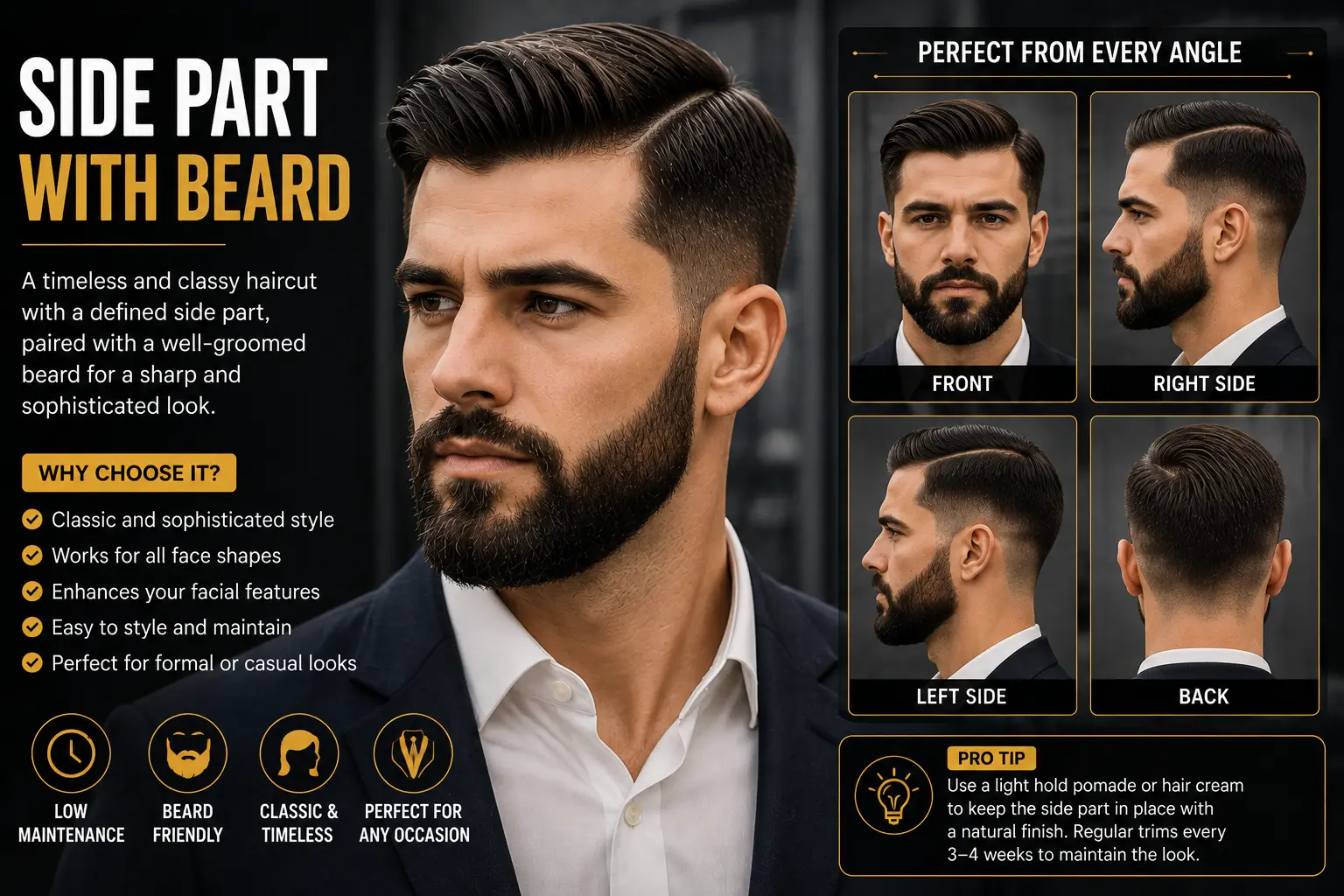
A side part with beard is one of the few style pairings where the haircut length barely matters as much as the styling technique itself. You can wear it with a short crop, a medium Ivy League cut, or hair long enough to comb over completely, and it still reads as the same classic look — a defined line where hair splits, combed neatly to one side, with a groomed beard underneath to finish it off.
This guide covers the different types of side parts, how much length you need to actually create one, which products work best, and how to pair it with the right beard for your face shape.
Table of Contents
What Is a Side Part with Beard
A side part is a hairstyle where hair is combed in two directions from a defined line, usually positioned above one eyebrow, with the smaller section swept one way and the larger section swept the other. It’s one of the oldest documented men’s hairstyles still in regular rotation at barbershops today.
A side part with beard pairs that classic combed style with facial hair, typically short to medium in length, to add structure at the jaw and balance out the formality of the parted hair on top. It’s a combination that reads as put-together without looking overly done, which is exactly why it’s stayed a staple for weddings, interviews, and everyday professional settings.
It’s a Styling Choice, Not a Haircut Length
This is worth clearing up early, because it’s the source of most confusion around the term. Unlike a crew cut or a Caesar cut, a side part isn’t a specific haircut length — it’s how the hair is styled once it’s cut. You can have a side part on a short Ivy League haircut with beard, a medium-length cut, or hair that’s noticeably longer on top.
What actually determines whether a side part looks sharp or messy is the length and thickness of hair on top, the depth of the part line, and how much product is used to hold it in place. Get those three things right, and the specific haircut underneath becomes almost secondary.
Types of Side Parts
| Type | Description | Best For |
| Soft Part | Natural-looking, styled but not sharply defined | Everyday, casual wear |
| Hard Part | A shaved or razor-cut line marking the part | Bold, modern styling |
| Deep Part | Part line sits further to one side than center | Adds height and structure |
| Comb Over Part | Hair is styled longer and combed fully across | Formal, classic occasions |
The hard part has become especially popular in the last several years, giving the part line a crisp, almost shaved-in look that pairs particularly well with a fade on the sides. It’s a bolder statement than the traditional soft part, and barbers usually create it with a straight razor or detail trimmer along the natural part line.
How Much Hair Length You Actually Need
A common mistake is trying to create a side part with hair that’s simply too short. As a general guide:
- Minimum length: Around 2 inches on top gives just enough to comb into a basic part.
- Comfortable length: 2.5 to 3.5 inches allows for a cleaner line and more product control.
- Comb-over length: 4 inches or more, needed for the classic comb-over version of a side part.
If your hair is currently too short, a barber can usually shape the beginnings of a part line while you grow the top out, so it doesn’t look unstyled in the meantime.
Best Face Shapes for a Side Part with Beard
| Face Shape | Part Style Recommendation | Beard Pairing |
| Round | Deep side part for added height and angles | Boxed beard with defined edges to add length |
| Square | Soft or hard side part, either works | Short beard or stubble, keep proportions clean |
| Oval | Most flexible, any part style suits | Wide range of beard lengths work |
| Long | Standard side part, avoid excessive height | Fuller sides, shorter chin to balance |
| Heart | Soft side part with moderate volume | Fuller at the chin to balance a wider forehead |
For a closer look at matching beard length to your specific face shape, the guides on best beard for round face, best beard for square face, and best beard for heart face break this down in more detail.
Beard Styles That Pair Best
Because a side part reads as classic and structured, it tends to pair best with beards that share that same sense of order.
- Short beard — the most natural match, structured enough to complement a defined part line. See short beard styles.
- Corporate beard — ideal for the formal comb-over or hard part versions worn in professional settings. Covered in the corporate beard guide.
- Stubble — works well with a soft side part for a more relaxed, everyday combination. Full details in the stubble beard guide.
- Van Dyke beard — for men who want a more deliberate, shaped beard style to match a hard part’s sharp line. See Van Dyke beard.
Fuller, longer beards can work with a side part too, particularly a soft, natural-looking version, though they shift the whole look toward rugged rather than polished. A Garibaldi beard paired with a sharp hard part tends to fight itself visually rather than complement.
Choosing the Right Product
Product choice makes or breaks a side part more than almost any other styling variable.
| Product | Finish | Hold | Best For |
| Pomade (oil-based) | High shine | Medium | Classic, vintage-style side parts |
| Pomade (water-based) | Low to medium shine | Strong | Everyday wear, easier to wash out |
| Clay | Matte | Strong | Modern, textured side parts |
| Wax | Low shine | Strong | Fine hair needing extra grip |
A water-based pomade is generally the safest starting point since it holds well without the heavy shine of oil-based versions, and it washes out easily without buildup.
How to Create a Side Part Step by Step
- Start with damp, towel-dried hair. Fully wet hair makes it hard to see where the part will actually sit once dry.
- Decide your natural part. Run your fingers through wet hair and let it fall — most heads have a natural part direction already.
- Apply product to your palms first. Warm it up before applying so it distributes evenly rather than clumping in one spot.
- Comb the smaller section back and slightly across. This creates the base of the part line.
- Comb the larger section over, covering the part slightly at the root. This gives volume and avoids a flat, overly combed look.
- Use a comb to sharpen the part line. For a hard part look, a barber uses a razor or trimmer for this step instead.
- Finish the beard to match. Brush it into shape with a beard comb so the whole look feels coordinated rather than separately styled.
Give it a minute or two to dry and set before touching it again — moving it too soon while wet tends to soften the line you just created.
Hair Type Considerations
| Hair Type | Fit for a Side Part |
| Straight | Easiest to work with, holds a clean line naturally |
| Wavy | Works well, adds subtle texture without fighting the part |
| Curly | Needs extra product and often a longer length; check the curly beard care guide if the beard is curly too |
| Thick | Handles hard parts and comb-overs particularly well |
| Fine | Benefits from wax or strong-hold pomade to avoid the part falling out during the day |
How to Ask Your Barber for It
- Ask for enough length left on top to comb into a side part, specifying 2.5 to 4 inches depending on the version you want.
- Specify soft, hard, or deep part so your barber knows how defined the line should be.
- Mention the side treatment: taper, low fade, or skin fade, especially if you want a hard part to contrast against it.
- Ask for the beard to be shaped in the same visit so both areas match in precision.
- If you’re unsure which part direction suits you, ask your barber to check your natural growth pattern before committing to a side.
Maintenance and Daily Upkeep
Hair:
- Trim every 4–5 weeks to keep enough length for the part without it growing shapeless
- Reapply product daily, since a side part rarely holds well on second-day hair without a touch-up
- Keep a comb on hand for quick fixes throughout the day
Beard:
- Trim every 1–2 weeks using a reliable beard trimmer to match the precision of the haircut
- Apply beard oil daily to prevent dryness and keep the beard soft against a well-groomed haircut
- Wash with a dedicated beard wash rather than regular shampoo
- Keep the beard neckline and beard cheek line fresh, ideally weekly
The beard care guide has a complete breakdown of washing order and frequency if you’re building a full routine.
Suitable for Work, Weddings, and Formal Events
A side part with beard is arguably the most formal-leaning combination among short-to-medium haircuts, which makes it a dependable choice for interviews, client meetings, and office beard styles generally. The hard part version leans slightly more modern and casual, while the classic soft part or comb-over reads as more traditional.
For weddings specifically, get the haircut done 3–4 days before the event so the part settles into a natural fall, and do a final beard trim closer to the day itself. The wedding beard styles guide covers timing in more detail.
Best Age Groups
- Teens and 20s: Often the hard part version, paired with stubble or a developing short beard, popular for its modern edge.
- 30s and 40s: The classic soft side part tends to dominate here, paired with a fuller, more structured short beard for a professional finish.
- 50s and beyond: A dependable, timeless option, especially alongside greying or salt-and-pepper facial hair. The beard styles for men over 50 guide has more specific advice for this pairing.
Common Mistakes
- Not using enough product. A side part without adequate hold falls apart within a few hours, especially on straight or fine hair.
- Combing too flat. A part with no volume looks dated rather than classic; a slight lift at the root keeps it looking current.
- Ignoring the beard entirely. A sharp, defined part next to an unshaped beard looks unbalanced.
- Choosing the wrong part depth for your face shape. A very deep part on an already long face can exaggerate length unnecessarily.
- Skipping regular trims. A side part relies on length staying consistent; letting it grow out unevenly makes the part harder to maintain.
Myths About the Side Part
Myth: It only works on straight hair. Wavy and even curly hair can hold a side part with the right product and slightly longer length, though it takes more effort than straight hair.
Myth: A side part always looks old-fashioned. The hard part and deep part variations have given the style a distinctly modern update over the last several years.
Myth: You need a full beard to pair with it. Stubble or a short beard works just as well, and in many cases suits the formality of a side part better than a longer, fuller beard.
FAQs
What is a side part with beard? A side part with beard combines a classic parted hairstyle, where hair is combed in two directions from a defined line, with a groomed beard, typically short to medium length, for a polished overall look.
Is a side part a specific haircut or a styling choice? It’s a styling choice rather than a specific haircut length, which means it can be created on a short, medium, or longer haircut as long as there’s enough length on top to comb.
How much hair length do I need for a side part? At least 2 inches on top is the minimum, with 2.5 to 3.5 inches offering more control, and 4 inches or more needed for a full comb-over version.
What’s the difference between a soft part and a hard part? A soft part is a natural, styled line created with a comb, while a hard part is a sharply defined line, often shaved or razor-cut, giving a bolder and more modern finish.
What beard length works best with a side part haircut beard style? Short beard or stubble tends to work best, matching the structured, tidy nature of a well-groomed side part.
Is a side part with beard good for the office? Yes, it’s one of the most consistently professional-looking combinations available, particularly the classic soft part or comb-over versions.
What product should I use for a side part? A water-based pomade offers a good balance of hold and manageable shine for most side parts, while clay suits a more matte, textured finish.
Does a side part with beard suit round faces? Yes, especially with a deeper part that adds height, paired with a beard shaped to add length and angles to the jaw.
Can I get a side part with curly hair? Yes, though curly hair usually needs slightly longer length and a stronger-hold product to keep the part defined throughout the day.
How often should I trim a side part haircut with beard? Trim the hair every 4–5 weeks and the beard every 1–2 weeks to keep the proportions and part line looking sharp.
How do I ask my barber for a side part? Specify how much length you want left on top, whether you want a soft or hard part, and how you’d like the sides treated, whether tapered or faded.
Does a side part work with a fade? Yes, a hard part especially pairs well with a fade on the sides, since the contrast between the tight sides and the defined part line adds to the sharp, modern look.
Is a side part with beard suitable for weddings? Yes, it’s a popular choice for weddings and formal events, particularly styled with a classic soft part and a neatly trimmed beard.
Can teenagers wear a side part with beard? Yes, especially the hard part version, often paired with stubble or an early short beard as facial hair growth continues to develop.
Does a side part work for older men with thinning hair? It can, though a slightly shorter length and a deeper part often help minimize the appearance of thinning at the crown.
A side part with beard has stayed a barbershop staple for a simple reason: it adapts to almost any hair length, most face shapes, and a wide range of beard styles without losing its core identity. Get the part depth right for your face, pick a product that matches the finish you want, and keep the beard trimmed to match, and it holds up from a Monday meeting to a Saturday wedding. For more ways to pair facial hair with classic haircuts, the types of beard styles page is worth checking before your next appointment.