 By Bread Styles Team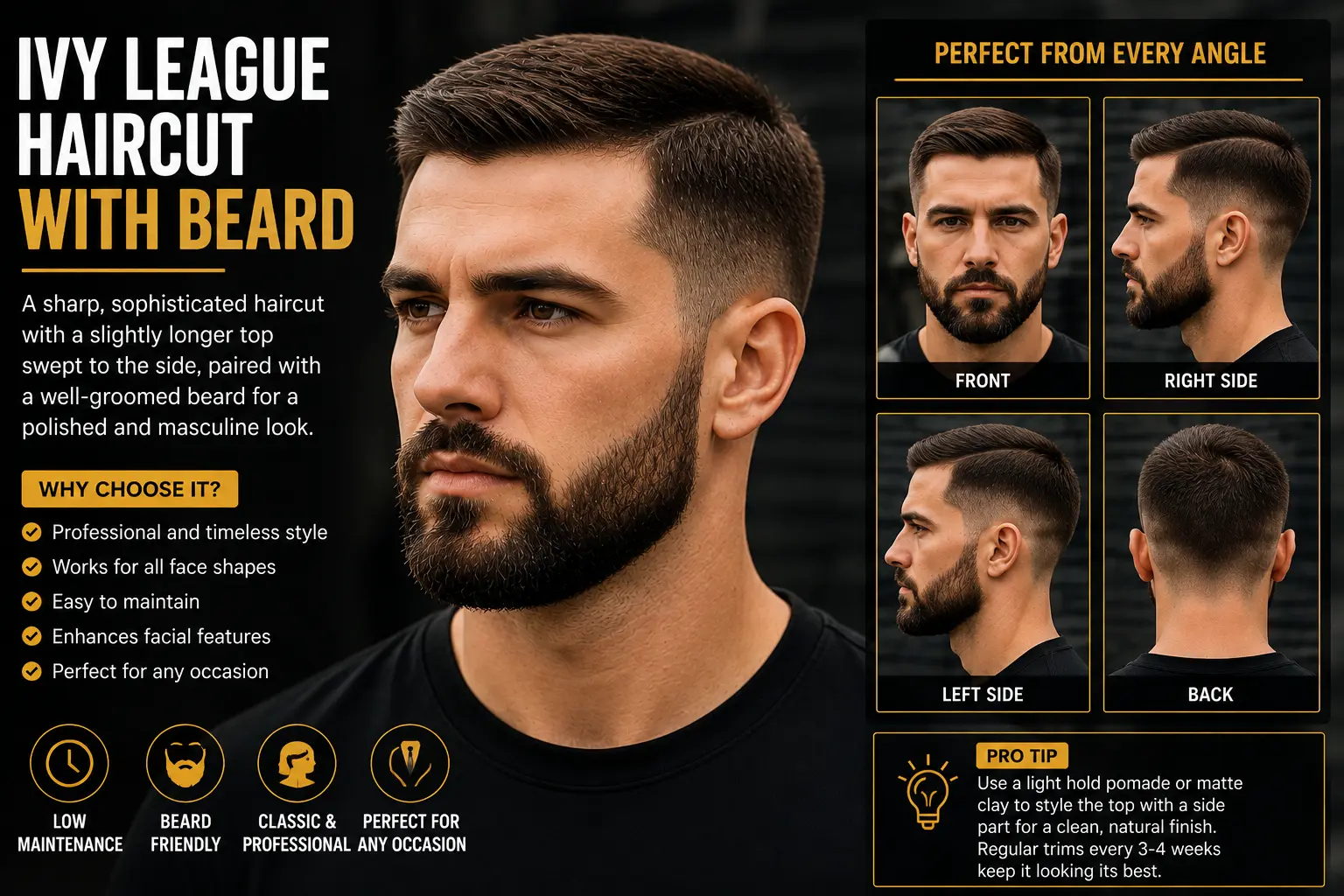
An Ivy League haircut with beard gives you more length on top than a crew cut without going anywhere near a full styled quiff or pompadour. It’s the cut barbers reach for when a client wants something that still looks sharp with minimal effort but has enough length to actually style a few different ways depending on the day.
This guide covers what separates it from similar short cuts, which beard styles suit it, how to style it properly, and the mistakes that make it look flat instead of finished.
Table of Contents
What Is an Ivy League Haircut with Beard
The Ivy League haircut is a short-to-medium length style with more length left on top than a standard crew cut, usually enough to comb, part, or push back with product. The sides stay short, tapered or faded, while the top has room for texture and shape.
Paired with facial hair, the Ivy League haircut with beard combination gives you a haircut that can shift between polished and relaxed depending on how you style it, matched with a beard that adds definition at the jaw. It’s a step up in versatility from a crew cut, and slightly less structured than an Ivy League beard paired with a sharp side part and pomade finish for formal occasions.
Because the top has enough length to actually style, this cut gives you more room to adapt your look week to week than most short haircuts.
Where the Name Comes From
The style takes its name from the Ivy League universities in the United States, where it became a common look among students and faculty in the mid-20th century, an alternative to the shorter, more severe military crew cut that was standard at the time. It offered a slightly longer, more personal styling option while still staying neat enough for academic and professional settings.
It’s sometimes called a Harvard clip for the same reason, and both names describe essentially the same haircut — short sides, more length on top, styled rather than left to fall naturally.
Ivy League vs Crew Cut vs Caesar Cut
These three short cuts get mixed up often enough that a direct comparison helps clear things up.
| Haircut | Top Length | Styling Effort | Best For |
| Ivy League | Medium-short, stylable | Moderate | Versatility, multiple looks |
| Crew Cut | Short, tapered | Minimal | Low maintenance |
| Caesar Cut | Short, forward fringe | Minimal | Classic, receding hairlines |
If your priority is the least amount of daily effort, a crew cut with beard or Caesar cut with beard will ask less of you each morning. The Ivy League cut trades a bit of that simplicity for more styling options, which is exactly why it’s stuck around in barbershops for so long.
Three Ways to Style It
This is where the Ivy League haircut earns its reputation as one of the more adaptable short cuts.
1. Classic Side Part
Hair is combed with a defined part on one side, using a light pomade for hold and a touch of shine. This is the most traditional version and works especially well for formal or professional settings.
2. Textured Push-Back
Hair is styled straight back off the forehead using a matte paste, creating volume and texture rather than a slick, shiny finish. This version leans more modern and works well for casual and business-casual settings alike.
3. Textured Fringe Forward
Similar to a shorter French crop with beard, the front section is styled slightly forward and textured rather than parted or pushed back. This is the most casual of the three and suits thicker hair with natural movement.
Best Face Shapes for This Combination
| Face Shape | Styling Direction | Beard Recommendation |
| Round | Push-back or side part for added height | Boxed beard with sharp angles to add length |
| Square | Any of the three styles work | Short beard or stubble, avoid excess bulk |
| Oval | Most flexible face shape for this cut | Wide range of beard lengths suit it |
| Long | Side part with volume at the sides, not the top | Fuller sides, shorter chin length |
| Diamond | Textured push-back to soften cheekbones | Fuller jawline beard to balance a narrow chin |
For deeper guidance on identifying your face shape and pairing beard length correctly, see best beard for round face, best beard for long face, and best beard for diamond face.
Beard Styles That Work Best
The Ivy League cut has enough presence on top that it pairs comfortably with a wider range of beard lengths than shorter, flatter haircuts.
- Stubble — keeps the whole look relaxed, especially with the textured push-back styling option. See the stubble beard guide.
- Short beard — the most common pairing, structured enough to match a side-parted Ivy League beard look. Full details in short beard styles.
- Corporate beard — ideal when the haircut is styled with a classic side part for office or client-facing roles. See corporate beard.
- Medium beard — works well with the textured push-back version, since both have a bit more volume and movement. Covered in medium beard styles.
Longer beards, like a full Bandholz beard, can work too, particularly with the textured fringe-forward styling, though they shift the whole look toward rugged rather than polished.
Step-by-Step Styling Guide
- Start with damp, towel-dried hair. Fully dry hair won’t distribute product evenly.
- Choose your product based on the finish you want. Pomade for a side part and shine, matte clay or paste for texture and push-back.
- Decide on your part or direction. For a side part, comb a clean line where your hair naturally falls. For push-back, use your fingers to lift hair up and back from the front.
- Blow-dry briefly if you want more volume. A few seconds with a dryer on low heat, lifting at the roots, adds noticeable lift without much effort.
- Set the beard afterward. Brush it into shape with a beard comb so the whole look feels finished together rather than styled separately.
Most men get through this in two to three minutes once they’ve settled on their preferred version.
Hair Type Considerations
| Hair Type | Fit for the Ivy League Cut |
| Straight | Works well with a side part; needs product to hold push-back styles |
| Wavy | Excellent for the textured push-back look, holds shape naturally |
| Curly | Suits the fringe-forward variation best; check the curly beard care guide if your beard is curly too |
| Thick | Handles all three styling options well, gives the most volume |
| Fine | Works best with a side part and light hold product to avoid looking flat |
How to Request It at the Barbershop
- Ask for short, tapered or faded sides with more length left on top, roughly 2–3 inches depending on how much styling flexibility you want.
- Specify which finish you’re after: side part, push-back, or textured fringe.
- Mention the side treatment: taper, low fade, mid fade, or skin fade.
- Ask for the beard to be lined up in the same session so the cheek line and neckline match the precision of the haircut.
- If you switch between styling options during the week, tell your barber — they can leave enough length on top to support all three.
Maintenance Routine
Hair:
- Trim every 4–5 weeks, slightly longer than a crew cut since there’s more length to manage
- Keep two products on hand: a pomade for formal days and a matte paste for casual styling
- Wash regularly to prevent product buildup, especially if using pomade often
Beard:
- Trim every 1–2 weeks with a good beard trimmer to keep pace with the more styled haircut
- Apply beard oil daily to keep the skin underneath healthy
- Wash with a dedicated beard wash rather than regular shampoo
- Keep the beard neckline and beard cheek line sharp, ideally weekly
The beard care guide covers washing order and frequency in more depth if you’re building a routine from the ground up.
Suitable for Work and Formal Occasions
The Ivy League haircut with beard is genuinely one of the most adaptable options for professional settings, since the side-part version reads as classic and formal while the textured push-back leans more relaxed for weekends. It’s a strong match for office beard styles and works equally well for interviews, client meetings, or wedding beard styles when styled with a defined part and a neatly trimmed beard.
For formal events, get the haircut done 3–4 days ahead so it settles into its natural fall, and do a final beard trim a day or two before to keep everything sharp in photos.
Best Age Groups
- Teens and 20s: Popular with the textured push-back or fringe-forward styles, usually paired with stubble as facial hair growth continues to fill in.
- 30s and 40s: Often the classic side-part version, paired with a fuller, more defined short beard for a polished, professional look.
- 50s and beyond: Works well with either styling option, particularly alongside greying or salt-and-pepper facial hair. The beard styles for men over 50 guide has more specific pairing advice for this age range.
Common Mistakes
- Cutting too short on top. This turns an Ivy League cut into a crew cut and removes the styling flexibility that makes it worth choosing in the first place.
- Using the wrong product for the look you want. Pomade for a matte, textured finish looks greasy; matte paste for a slick side part won’t hold properly.
- Letting the beard fall behind the haircut’s precision. A structured, styled haircut next to an untrimmed beard looks mismatched.
- Skipping regular trims. Because there’s more length on top, this cut grows out and loses shape faster than a crew cut if left too long between visits.
- Overloading with product. More isn’t better — a small amount, properly distributed, holds better than a heavy application.
Myths About the Ivy League Cut
Myth: It’s only for formal, corporate settings. The textured push-back and fringe-forward versions are genuinely casual and work fine outside the office.
Myth: It requires the same daily effort as a full pompadour. It needs less. Most versions take two to three minutes with the right product, well short of a full pompadour routine.
Myth: It only suits straight hair. Wavy and curly hair actually work well with certain versions of this cut, particularly the fringe-forward style.
FAQs
What is an Ivy League haircut with beard? An Ivy League haircut with beard pairs a short-sided, medium-length top haircut, styled as a side part, push-back, or textured fringe, with a groomed beard for a polished but flexible look.
Where does the Ivy League haircut get its name? It’s named after Ivy League universities in the United States, where it became popular in the mid-20th century as a slightly longer alternative to the standard crew cut.
What’s the difference between an Ivy League cut and a crew cut? An Ivy League cut leaves more length on top for styling into a part or push-back, while a crew cut is uniformly short and tapers directly into the sides with little styling needed.
Is an Ivy League beard style good for the office? Yes, particularly the classic side-part version, which is one of the more traditional, professional-looking haircut and beard pairings available.
How often should I trim an Ivy League haircut with beard? Trim the hair every 4–5 weeks and the beard every 1–2 weeks to keep both looking sharp and proportionate.
What beard length works best with this haircut? Short beard or stubble works best for most styling options, though a medium beard pairs well with the textured push-back version.
Can I style an Ivy League cut different ways? Yes, that’s part of its appeal. The same haircut can be styled as a classic side part, a textured push-back, or a forward fringe depending on the occasion.
Does an Ivy League haircut suit curly hair? Yes, especially the fringe-forward variation, which lets natural curl pattern show instead of forcing hair into a slicked side part.
What products do I need for this style? A pomade for a classic side part and a matte clay or paste for textured, push-back styling cover most versions of this cut.
How do I ask my barber for an Ivy League haircut? Describe it as short, tapered sides with 2–3 inches of length left on top for styling, and specify whether you want a side-part or push-back finish.
Is an Ivy League beard suitable for round faces? Yes, particularly with a push-back or side-part style that adds height, paired with a beard shaped with sharper angles to add visual length.
What’s the difference between an Ivy League cut and a Caesar cut? An Ivy League cut has more length on top for styling into different shapes, while a Caesar cut is shorter overall with a straight, forward-combed fringe and minimal styling.
Can teenagers get an Ivy League haircut with beard? Yes, it’s a common choice for younger men, usually paired with light stubble or an early short beard as facial hair growth develops.
Does an Ivy League cut work with thinning hair? It can work, though very thin hair at the crown may benefit from a slightly shorter length on top to avoid drawing attention to sparse areas.
How long does hair need to be for an Ivy League cut? Generally 2–3 inches on top gives enough length to style it as a side part, push-back, or textured fringe.
An Ivy League haircut with beard earns its long-standing popularity by doing something most short cuts don’t: giving you real styling options without demanding a long daily routine. Get the length right on top, keep the beard trimmed to match, and it adapts easily from a Monday morning meeting to a weekend without much rethinking. For more pairing ideas across other short haircuts, the types of beard styles page is a solid next stop before your next barber visit.