 By Bread Styles Team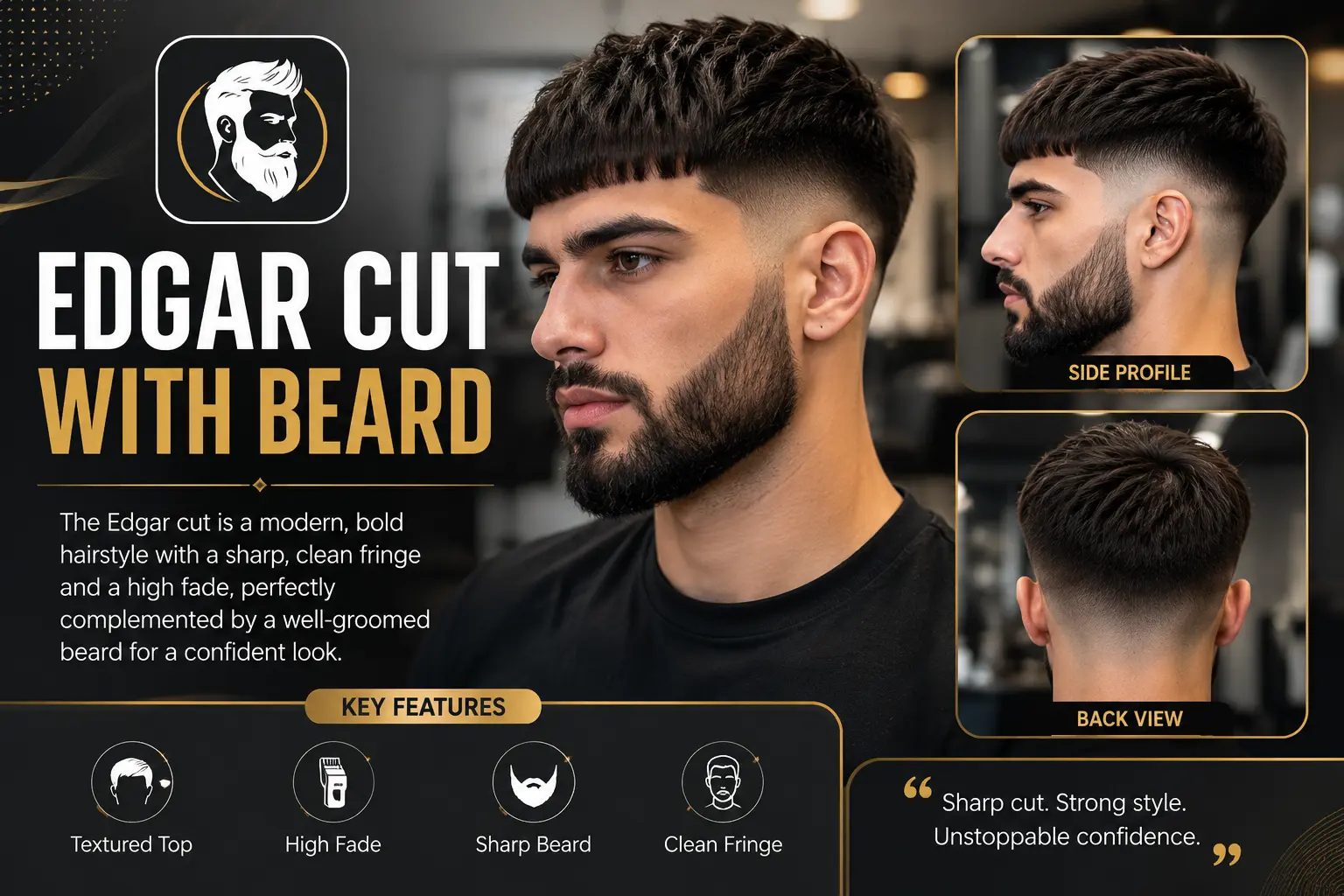
An Edgar cut with beard pairs a blunt, straight-across fringe with a high, tight fade on the sides, then finishes with facial hair, usually light stubble or a short beard, to add a bit more definition at the jaw. It’s become one of the most requested haircuts among teenagers and young men over the past few years, largely thanks to how sharp the horizontal fringe line looks against a skin-tight fade.
This guide breaks down exactly how an Edgar cut differs from a Caesar cut, which it’s frequently confused with, and covers the fade options, facial hair pairings, and upkeep that keep the style looking as crisp as it does on day one.
Table of Contents
What Is an Edgar Cut with Beard
An Edgar cut is a short haircut with a blunt, straight-across fringe sitting just above the eyebrows, often with a subtle point or slight widow’s peak at the center, paired with a high fade or skin fade on the sides. The top is left with minimal length, just enough to comb forward into the sharp fringe line.
An Edgar cut with beard combines that crisp fringe and fade combination with facial hair, typically light stubble given the younger demographic this style is most popular with, though a fuller short beard works just as well for men with more established growth. The Edgar haircut beard pairing has become a staple in barbershops that serve a younger, trend-conscious clientele.
Edgar Cut vs Caesar Cut
These two get confused constantly, and understanding the difference will help you communicate clearly with your barber.
| Feature | Edgar Cut | Caesar Cut |
| Fringe shape | Blunt, sharp, often pointed | Straight, softer edge |
| Fade | Always high or skin fade | Taper or low fade common |
| Top length | Very short, minimal texture | Slightly more length, uniform |
| Overall vibe | Sharp, modern, youth-driven | Classic, understated |
A Caesar cut with beard uses a softer, less severe fringe line and is typically paired with a taper or low fade rather than the dramatic skin fade that defines an Edgar cut. The Edgar cut pushes the contrast much further, combining an almost razor-sharp fringe edge with the highest, tightest fade the sides can support.
Where the Style Comes From
The Edgar cut takes its name from a barber, Edgar Aristizabal, whose work popularized this exact combination of a precise, blunt fringe and skin fade. It’s closely associated with Latino barbershop culture and gained significant traction through social media, particularly among teenagers and young men looking for a sharp, modern alternative to more traditional short cuts.
Unlike some trend-driven styles that fade quickly, the Edgar cut has held its popularity for several years now, likely because the core combination, a crisp fringe against a dramatic fade, photographs and holds its shape exceptionally well.
Best Face Shapes for an Edgar Cut with Beard
| Face Shape | Fringe Adjustment | Beard Recommendation |
| Round | Slightly shorter fringe | Boxed beard with sharp angles for added length |
| Square | Standard blunt fringe | Short beard or stubble, keep proportions clean |
| Oval | Flexible, most fringe lengths work | Wide range of beard lengths suit it |
| Long | Slightly longer fringe to shorten visual length | Fuller sides, shorter chin to add width |
| Heart | Standard fringe, softer point | Fuller at the chin to balance a wider forehead |
For more detail on pairing beard length with face shape, see best beard for round face, best beard for square face, and best beard for heart face.
Beard and Facial Hair Options That Work Best
Because the Edgar cut is especially popular with teenagers and men in their early twenties, facial hair growth is often still developing, so the recommendations here lean toward lighter options alongside more established beard styles for men with fuller growth.
- Light stubble — the most common pairing for younger men, adding definition without needing much growth. See the stubble beard guide.
- Short beard — works well once facial hair has filled in more, giving a clean, structured jawline. Covered in short beard styles.
- Circle beard — a minimalist option that keeps focus on the sharp fringe and fade. See circle beard for shaping guidance.
- Corporate beard — for slightly older men wearing this style in more professional settings. Covered in corporate beard.
If facial hair growth is patchy, which is common for younger men still developing a full beard, the patchy beard guide has specific advice on shaping around uneven areas rather than fighting them.
Fade Pairings for the Edgar Cut
The fade is doing a lot of the visual work in this haircut, and it’s almost always on the higher, more dramatic end.
| Fade Type | Contrast Level | Best For |
| High Fade | Strong | The most common Edgar cut pairing |
| Skin Fade | Maximum | The sharpest, most dramatic version |
| Burst Fade | Strong, curved | A rounder finish around the ear |
| Temple Fade | Moderate, focused | A subtler take that keeps more length at the back |
A high fade with beard or skin fade with beard are the two most requested pairings for this cut, since a lower fade doesn’t create enough contrast against the blunt fringe to give the style its signature sharpness. A burst fade with beard is a popular variation for men who want a slightly rounder, less severe line around the ear.
How to Style It
- Towel-dry hair to about 80%. The style needs minimal length on top, so heavy product isn’t usually necessary.
- Apply a small amount of light-hold cream or matte clay if styling is needed. Many Edgar cuts require little more than combing.
- Comb the fringe straight down and forward. The line should stay sharp and horizontal, not swept to one side.
- Check the fade edges for any stray hairs. Since the fade is such a dramatic part of this cut, a clean line makes a noticeable difference.
- Finish the beard or stubble to match. A quick pass with a beard comb keeps everything coordinated, even with lighter stubble.
Because the top is kept so short, daily styling for this cut is genuinely minimal, often under a minute.
Hair Type Considerations
| Hair Type | Fit for an Edgar Cut |
| Straight | Ideal, holds the blunt fringe shape with almost no effort |
| Wavy | Works well, may need a small amount of product to keep the fringe flat |
| Curly | Can work but generally needs to be worn slightly longer to keep the fringe from curling upward; check the curly beard care guide if pairing with a curly beard too |
| Thick | Handles the sharp fringe line well, holds its shape between trims |
| Fine | Works well, though the fade needs more frequent touch-ups to stay sharp |
How to Ask Your Barber for It
- Ask for a blunt, straight-across fringe cut just above the eyebrows, and mention if you want a slight point at the center.
- Specify a high fade or skin fade on the sides, since this contrast is central to the style.
- Bring reference photos, since the exact fringe shape and fade height can vary noticeably between barbers.
- Ask for facial hair to be shaped or lined up in the same visit for a coordinated finish.
- If your hair is curly, mention that too, so your barber can adjust the fringe length to account for how it sits once dry.
Maintenance and Daily Upkeep
Hair:
- Trim every 2–3 weeks, since the high fade grows out faster than lower fades or tapers
- Keep the fringe line sharp between visits with careful trimming at home if needed, or more frequent barber visits
- Minimal daily product required, since the style relies on the cut itself rather than heavy styling
Facial hair:
- Trim stubble or a short beard every 1–2 weeks with a reliable beard trimmer to keep pace with the sharpness of the haircut
- Apply beard oil daily, even with lighter stubble, to keep skin underneath healthy
- Wash with a proper beard wash rather than regular shampoo once facial hair is established enough
- Keep the beard neckline and beard cheek line defined, ideally weekly
The beard care guide has broader advice on building a routine, especially useful for younger men just starting to grow facial hair.
Suitable for School, Work, and Everyday Settings
Given how popular this cut is with teenagers, it tends to work well for school and casual everyday settings without much friction. For office beard styles in more conservative workplaces, a slightly lower fade and a well-groomed short beard, rather than light stubble, generally reads as more professional while keeping the core fringe and fade combination intact.
For more formal occasions, the sharp lines of an Edgar cut actually photograph well, though it’s worth getting a fresh trim 2–3 days before the event so the fade has time to settle slightly.
Best Age Groups
- Teens and early 20s: Where this style is overwhelmingly most popular, typically paired with light stubble or minimal facial hair as growth develops. The beard styles for teenagers guide has more specific advice for this age range.
- Mid-20s to 30s: Often worn with a fuller, more established short beard for a slightly more mature take on the same haircut.
- 40s and beyond: Less commonly worn, though a lower fade version paired with a tidy beard can still work for men who like the sharp fringe silhouette.
Common Mistakes
- Letting the fade grow out too long. High fades need more frequent trims than any other part of this cut to stay sharp.
- Combing the fringe to the side. This turns the style into something closer to a side part and loses the defining blunt, horizontal line.
- Ignoring facial hair shaping. Even light stubble benefits from a defined edge to match the precision of the haircut.
- Choosing too low a fade. Without enough contrast, the fringe doesn’t stand out the way it’s meant to.
- Skipping touch-ups between full haircuts. Because the fade grows out quickly, some men benefit from a quick fade refresh between full trims.
Myths About the Edgar Cut
Myth: It’s the same as a Caesar cut. The Edgar cut uses a sharper, more blunt fringe and is almost always paired with a high or skin fade, while a Caesar cut has a softer fringe edge and typically a lower fade or taper.
Myth: It only works for teenagers. While it’s most popular with younger men, the core combination works at any age, particularly with a slightly lower fade for a more understated version.
Myth: It requires a lot of daily styling. Because the top is kept so short, daily maintenance is minimal, often just a quick comb through the fringe.
FAQs
What is an Edgar cut with beard? An Edgar cut with beard combines a blunt, straight-across fringe with a high or skin fade on the sides, paired with facial hair, usually light stubble or a short beard depending on growth.
What’s the difference between an Edgar cut and a Caesar cut? An Edgar cut has a sharper, more blunt fringe paired almost always with a high or skin fade, while a Caesar cut has a softer fringe edge and typically a lower fade or taper.
Where does the Edgar cut get its name? It’s named after barber Edgar Aristizabal, whose work popularized this specific combination of a precise blunt fringe and dramatic fade.
Is an Edgar haircut beard style good for teenagers? Yes, it’s one of the most popular haircuts among teenagers and young men, typically paired with light stubble as facial hair growth develops.
What fade works best with an Edgar cut? A high fade or skin fade works best, since the strong contrast is central to the style’s signature sharp appearance.
How often should I get an Edgar cut trimmed? Every 2–3 weeks, since the high fade grows out faster than lower fades and needs regular maintenance to stay sharp.
Does an Edgar cut with beard suit round faces? Yes, particularly with a slightly shorter fringe, paired with a beard shaped to add length and angles to the jaw.
Can I get an Edgar cut with curly hair? Yes, though it’s often worn slightly longer than the straight-hair version to prevent the fringe from curling upward once it dries.
Is an Edgar cut with beard appropriate for school or work? It works well for school and casual settings, and for more conservative workplaces a slightly lower fade paired with a groomed short beard usually reads as more professional.
What beard style works best with an Edgar cut for younger men? Light stubble is the most common pairing, since it adds definition without requiring much facial hair growth.
How do I ask my barber for an Edgar cut? Ask for a blunt, straight-across fringe just above the eyebrows paired with a high or skin fade, and bring reference photos since styles vary between barbers.
What’s the difference between an Edgar cut and a French crop? An Edgar cut has a blunt, straight fringe with a dramatic fade, while a French crop with beard has more textured height at the fringe and is typically paired with a lower fade or taper.
Does an Edgar cut suit thinning hair? It can be difficult with thinning at the front, since the style relies on a full, blunt fringe line, though it may still work depending on where the thinning occurs.
Can older men wear an Edgar cut with beard? Yes, though it’s less common, and a lower fade paired with a fuller, well-groomed beard tends to suit older men better than the sharpest, highest-contrast version.
How long does hair need to be for an Edgar cut? Generally just 1 to 2 inches on top is enough to create the blunt fringe, since the style relies more on the fade contrast than length on top.
An Edgar cut with beard has held its popularity because the core idea, a razor-sharp fringe against a dramatic fade, genuinely photographs and wears well across a wide range of ages once you adjust the fade height and facial hair to suit. Keep the fade fresh, the fringe line precise, and pair it with whatever level of facial hair matches your growth, from light stubble to a fuller short beard. For more haircut and beard pairings, the types of beard styles page is worth a look before your next barber visit.