 By Beard Style
Table of Contents
Curly facial hair has its own personality. It doesn’t lie flat, it doesn’t follow the same trim lines as straight hair, and it needs a slightly different approach if you want it to look intentional rather than wild. That’s the good news and the tricky part at the same time: curly beard styles have more texture and character built in, but they also punish neglect faster than straight beards do.
This guide walks through the curly beard styles worth trying, which ones suit which face shapes, and how to actually manage the curl instead of fighting it. There’s also a dedicated section for men growing a beard later in life, because curls behave differently once gray and white hairs enter the mix.
What Counts as a Curly Beard (And Why It Behaves Differently)
A curly beard is facial hair that grows in a spiral or “S” pattern rather than growing straight down from the follicle. Genetics decide this, not grooming habits, so no product will permanently straighten it. What products can do is control frizz, define the curl pattern, and keep the beard looking shaped rather than tangled.
Curly hair strands are also naturally drier than straight hair. The oval or ribbon-shaped follicle bends as it grows, which makes it harder for natural sebum to travel down the shaft. That’s why curly beards tend to look coarser and feel rougher unless they’re conditioned regularly, and it’s the main reason curly beard maintenance looks a bit different from straight-beard care covered in a general beard care guide.
Quick answer: Curly beard styles work best when the length is long enough to show the curl pattern (usually 3 weeks of growth or more) but kept tidy at the neckline and cheek line so the shape still reads as deliberate.
The Best Curly Beard Styles to Try
Not every style suits curly hair equally. Some shapes let the curl do the talking, while others fight against it. Here are the looks worth considering, roughly ordered from lowest to highest maintenance.
1. Curly Stubble
Short curly growth, usually 5 to 10 days in, gives a textured shadow without much shaping work. It suits men who want a rugged look without committing to a full beard, and it pairs naturally with the guidance in this stubble beard breakdown.
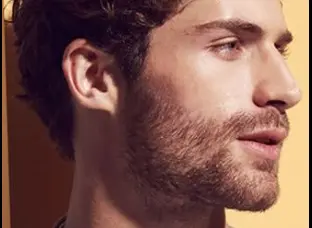
2. Short Curly Beard
At around 2 to 4 weeks, curls start forming visible loops rather than just kinks. A short beard style with curls looks neat with minimal daily effort, which makes it a strong choice for first-time curly beard growers.
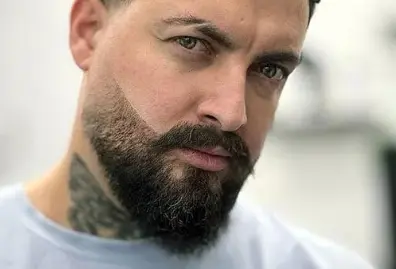
3. Medium Curly Beard
This is where curls really show their shape. A well-defined medium beard with curls needs a firm cheek line and neckline to avoid looking like it’s spreading unchecked, but it rewards that upkeep with real volume and texture.
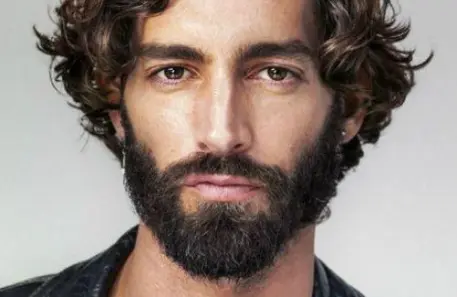
4. Long Curly Full Beard
Curls at longer lengths can look spectacular or genuinely messy, with very little middle ground. A long beard style built on curly hair needs regular conditioning and occasional detangling to avoid matting, especially where the mustache meets the beard.
5. Curly Goatee
For men who get patchy growth on the cheeks but full curls on the chin, a goatee style built around natural curl can look sharp and deliberate rather than sparse.
6. Curly Balbo
The Balbo’s disconnected mustache and chin patch works surprisingly well with curls because the style already relies on clean negative space. A Balbo beard with curl definition tends to photograph well and suits rounder jaws.
7. Curly Garibaldi
Big, rounded, and full, the Garibaldi beard is one of the most forgiving styles for curly hair since it doesn’t rely on sharp lines. The natural curl adds volume exactly where this style wants it.
8. Curly Bandholz
A longer, fuller, all-natural growth like the Bandholz beard suits curly hair particularly well, since the whole point of the style is letting facial hair grow with minimal interference. Curl pattern becomes the main visual feature.
9. Curly Circle Beard
A tighter, more defined circle beard works with looser curls rather than tight coils, since very tight curl patterns can blur the clean outline this style depends on.
Table: Curly Beard Style Comparison
| Style | Length Needed | Maintenance Level | Best For |
| Curly Stubble | 5–10 days | Low | Everyday low-effort look |
| Short Curly Beard | 2–4 weeks | Low-Medium | First-time growers |
| Medium Curly Beard | 4–8 weeks | Medium | Defined, professional texture |
| Long Curly Full Beard | 3+ months | High | Bold, natural statement |
| Curly Goatee | Ongoing trim | Medium | Patchy cheek growth |
| Curly Balbo | Ongoing trim | Medium-High | Rounder jawlines |
| Curly Garibaldi | 4+ months | Medium | Full faces, forgiving shape |
| Curly Bandholz | 6+ months | Low (shaping-wise) | Natural, low-fuss growth |
| Curly Circle Beard | Ongoing trim | High | Loose curls, defined outline |
Curly Beard Styles by Face Shape
Curl pattern adds width and visual weight, which changes how a beard interacts with face shape compared to straight facial hair.
- Round faces generally look better with more length at the chin and less width at the sides, since curls already add width. See specific guidance in best beard for round face.
- Oval faces can wear almost any curly style since the proportions are already balanced; check best beard for oval face for style pairings.
- Square faces benefit from rounder curly shapes like the Garibaldi or Bandholz, softening strong jaw angles, as detailed in best beard for square face.
- Diamond faces do well with fuller cheek coverage from curls to balance a narrower jawline, covered in best beard for diamond face.
- Heart-shaped faces usually need more volume at the chin, which curly hair provides naturally; see best beard for heart face.
- Oblong faces should avoid adding excessive length, since curls can extend the face further; the best beard for oblong face guide has specific length recommendations.
- Triangle faces often look best with fuller curls around the jaw to add width where it’s naturally missing, explained further in best beard for triangle face.
Men dealing with uneven growth alongside curls should also read the patchy beard guide, since curl pattern can sometimes hide thin patches better than straight hair does.
Curly Beard Styles for Senior and Mature Men
Curly facial hair changes again with age, and this is where most generic beard guides fall short. Hair diameter, curl tightness, and growth speed all shift over time, and gray or white strands behave differently from pigmented ones.
Why Senior Beard Styles Need a Different Approach
Beard hair tends to grow coarser and sometimes curlier with age, while scalp hair often does the opposite. For men exploring senior beard styles, that coarser curl usually needs more length to look intentional rather than wiry, since very short curly-gray stubble can look unkempt more easily than short curly dark stubble does.
White Beard Styles and Curl Definition
Gray and white hair reflects light differently, which actually makes curl pattern more visible, not less. White beard styles that lean into medium-to-long curly shapes, like a curly Bandholz or a rounded Garibaldi, tend to look distinguished rather than unruly, because the visible curl reads as texture instead of frizz. Very short, tightly trimmed white stubble can sometimes look patchier than it really is, simply because gray hair is less visually dense.
Mature Beard Looks That Work With Curl
Mature beard looks generally favor cleaner lines around the neck and cheeks even when the beard itself is fuller, since a sharp perimeter signals grooming and control. Combining curl volume on top with a crisp beard neckline and beard cheek line is one of the most reliable ways to keep a curly, graying beard looking sharp rather than overgrown.
Beard After 50: Realistic Expectations
Beard after 50 growth is often slower and patchier in spots than it was at 25, and curl pattern can become slightly looser as hair thins. That’s normal, not a grooming failure. Men in this stage often get the best results from styles that don’t demand perfect density everywhere, such as the Balbo or a well-shaped goatee, both of which work with partial coverage rather than against it. Fuller-coverage guidance for this age group is available in beard styles for men over 50 and beard styles for men over 40.
Men with thinning hair on top often pair a fuller curly beard with a shaved or closely cropped head, a combination worth reviewing in the beard styles for bald men guide, since the contrast tends to draw attention downward to a well-groomed beard.
How to Grow a Curly Beard That Actually Looks Good
Step 1: Commit to at least four weeks of no shaping. Curl pattern doesn’t fully reveal itself until there’s enough length. Trimming too early just removes the texture you’re trying to grow.
Step 2: Comb, don’t just brush, in the first few weeks. A wide-tooth comb detangles curls without pulling them straight the way a boar-bristle brush can.
Step 3: Set a neckline once growth passes two weeks. Even during the growing-out phase, defining where the beard stops on the neck keeps the whole look under control. Full technique is covered in how to trim a beard.
Step 4: Condition daily, not weekly. Curly hair loses moisture faster. Skipping days lets frizz build up and makes the curl pattern harder to read.
Step 5: Trim for shape, not length, once you hit your target. At this stage the goal is maintaining the outline of whichever beard style you’ve chosen, not cutting length back.
Daily Maintenance for Curly Facial Hair
- Wash 2 to 3 times a week with a beard-specific cleanser; daily washing with regular shampoo strips natural oils curly hair needs.
- Apply beard oil to damp hair, not dry hair, so it seals in moisture rather than sitting on top.
- Use a leave-in conditioner or beard balm on days with high humidity, since curls frizz more in damp air.
- Detangle from the ends upward, never from the root down, to avoid breakage.
- Trim split ends every 3 to 4 weeks even if you’re growing length, since split curly ends fray more visibly than split straight ends.
Common Mistakes Curly-Bearded Men Make
- Trimming too short too often. Curly beards look best with some length to show the pattern; constant short trims keep it looking like unshaped stubble.
- Using scalp shampoo on the beard. It’s typically too harsh and dries out already moisture-hungry curly strands.
- Skipping the neckline. Curl volume without a defined perimeter reads as unkempt rather than full.
- Brushing dry curls aggressively. This breaks up the curl pattern and creates frizz instead of shape.
- Ignoring cheek line drift. Curly hair can obscure where the natural cheek line sits, so it’s easy to let it creep upward unnoticed.
Products That Actually Help Curly Beards
| Product | Purpose | When to Use |
| Beard oil | Softens hair, adds shine, reduces frizz | On damp beard, morning and night |
| Leave-in conditioner | Deep moisture for coarse curls | After washing, 2–3x weekly |
| Beard balm | Light hold, shape control | Daytime styling |
| Wide-tooth comb | Detangling without breakage | Daily, on damp hair |
| Boar bristle brush | Distributing oil, light shine | Occasionally, on longer growth only |
Avoid heavy waxes on curly beards longer than stubble length. They tend to clump curls together rather than defining them individually, which flattens the texture that makes curly beard styles distinctive in the first place.
Myths About Curly Beards, Cleared Up
Myth: Curly beards grow slower than straight beards. Growth rate is determined by genetics and hormones, not curl pattern. Curly beards can simply look shorter because the spiral shape uses more length to cover less vertical distance.
Myth: Shaving makes curly hair grow back thicker or straighter. Shaving doesn’t change follicle shape. Regrowth will follow the same curl pattern as before.
Myth: Curly beards can’t be neat. A well-maintained neckline, cheek line, and regular conditioning make curly beards just as tidy-looking as straight ones. The texture is different, not the tidiness.
Myth: Product will permanently loosen or tighten the curl. Products can temporarily manage frizz and definition, but the underlying curl pattern is genetic and returns once product wears off or hair is washed.
For readers exploring the wider landscape of facial hair before settling on a curly look, the full types of beard styles overview is a useful starting point, and the American Academy of Dermatology publishes general guidance on healthy beard and skin care worth reviewing alongside any styling decision.
Curly beard styles reward patience more than any other beard texture. The curl itself does a lot of the visual work once there’s enough length to show it, and the main job for anyone growing one is keeping the perimeter clean and the hair properly moisturized. Whether that means a short curly stubble look, a full curly Bandholz, or a distinguished white curly beard after 50, the same core habits apply: grow it out before judging it, condition it often, and let the natural pattern lead the style rather than fighting it into a shape it was never going to hold.
Frequently Asked Questions
1. What is the best length for curly beard styles? Most curly beard styles need at least 3 to 4 weeks of growth before the curl pattern becomes visible enough to shape intentionally. Shorter growth tends to look like uneven stubble rather than defined curls.
2. Do curly beards need more maintenance than straight beards? Yes, generally. Curly hair is drier by nature, so it needs more frequent conditioning and gentler detangling to avoid frizz and breakage.
3. What causes a beard to grow curly? Follicle shape determines curl pattern. Oval or curved follicles produce curly or wavy hair, while round follicles produce straight hair. This is genetic and can’t be permanently changed by grooming.
4. Can I straighten my curly beard permanently? No safe permanent method exists for facial hair the way it does for scalp hair. Heat styling or chemical relaxers made for scalp hair are not recommended for the face and carry higher risk of skin irritation.
5. What are the best senior beard styles for curly hair? Fuller, rounder shapes like the Garibaldi or Bandholz tend to suit curly gray and white hair well, since they let the curl pattern show as texture rather than requiring sharp, hard-to-maintain lines.
6. Do white beard styles look different with curly hair than straight hair? Yes. White and gray hair reflects more light, which makes curl pattern more visible. A curly white beard often looks fuller and more textured than a straight white beard of the same length.
7. Is a beard after 50 harder to grow with curly hair? Growth can slow and become slightly patchier with age regardless of hair texture. Curly hair may also loosen slightly as strands thin, which is a normal part of aging rather than a grooming issue.
8. What mature beard looks work best for thinning or patchy curly growth? Styles that don’t rely on uniform density everywhere, like a Balbo or a well-defined goatee, tend to work better for patchier growth than full, all-over styles.
9. How often should I wash a curly beard? Two to three times a week with a beard-specific cleanser is usually enough. Washing daily with regular shampoo can strip the oils curly beards need to stay soft.
10. Should I comb or brush a curly beard? A wide-tooth comb is gentler on curl pattern than a brush. Brushes, especially on dry hair, tend to pull curls straighter and create frizz.
11. Can beard oil change how curly my beard looks? Beard oil won’t change curl pattern, but it can make curls look more defined and less frizzy by adding moisture and reducing static.
12. What’s the biggest mistake men make with curly beard styles? Trimming too short too often. Curly beards need length to show their pattern, so frequent short trims usually make a beard look like unshaped stubble instead of a defined style.
13. Do curly beards suit every face shape? Most face shapes can wear some form of curly beard, but the specific style matters. Rounder curly shapes suit square jaws, while fuller cheek coverage suits narrower diamond or heart-shaped faces.
14. Is it true curly beards grow slower? No. Growth rate depends on genetics and hormones, not curl pattern. Curly hair can simply appear shorter because the spiral shape covers less vertical distance per inch of actual hair growth.